

Friday, January 11, 2013


Wednesday, January 9, 2013
Coming Soon to the Dollar
Two funny tidbits about the Treasury Secretary's signature on the dollar bill.
Catherine Rampell in the New York Times points out Obama's presumptive nominee, Jacob Lew's, ridiculous signature:

Oh no! The horror of having this ridiculous thing on our money!
But then Marketplace does one better in their old piece on Timothy Geithner and his normal signature:

And the way he changed it for US currency:

Whew, we can all relax. Thank goodness.
[HT: @EthanLindseyMMR]
Catherine Rampell in the New York Times points out Obama's presumptive nominee, Jacob Lew's, ridiculous signature:

Oh no! The horror of having this ridiculous thing on our money!
But then Marketplace does one better in their old piece on Timothy Geithner and his normal signature:

And the way he changed it for US currency:
Whew, we can all relax. Thank goodness.
[HT: @EthanLindseyMMR]
Tuesday, January 8, 2013
Economist's Notebook: Western Cities

I spent the weekend at the American Economics Association annual meetings being held this year in San Diego. As has been the case for the last few years, I saw none of the actual conference because I spent the entire weekend in a hotel room interviewing candidates for two open positions in the department (not new - we had two departures from the department at the end of the academic year). But it was my first time in San Diego and I did a fair amount of wandering the downtown, and though downtown is not really where you want to be when you go to San Diego, it was still quite interesting to me.
To me downtown San Diego felt just like downtown Denver from the new downtown baseball stadium to the historic district turned into a bar and restaurant spot, the broad avenues devoid of traffic to the distinct absence of residential hosing. It felt nice and relaxed but a little bit marginal. The Gaslamp district to me was a little bit scuzzy (more so than LoDo in Denver) but the revitalized waterfront was pretty nice (though mostly dominated by big hotels). My take on these western ghost town downtowns in the west is quite different than the de-urbanization that happened in the east.
In places like Denver and San Diego I have this impression of early cities that were developing an urban core around stockyards and ports, respectively, when the automobile and the increased mobility of American society had a transformative effect. Western cities have beautiful landscapes and the automobile allowed folks to live in more picturesque suburbs and close to the natural beauty that surrounded them (yes, Denver sits on a dry arid high plain by the mountain views are spectacular and thus folks spread out along the front range), perhaps despite the pleasant livable downtown areas rather than because of urban blight as in the eastern city. Later, more and more folks moved to these cities by choice precisely because of the allure of the natural beauty and climate, and these folks were not looking for urban amenities as much as suburban space and nature. Thus the massive sprawl took off. In Denver it is vivid and impressive, and San Diego seems equally so.
It is only now that these downtowns are starting to infill residential and mixed use amenities in an effort to create more vibrant and lively spaces. This process is slow. I was very amused to see the San Diego Streetcar that circulates the downtown area as well as the number of new condo towers that I imagine sprung up in the early 2000s like they did everywhere including Portland. The streetcar has become the darling of urban renewal (thanks in part to Portland) but I am not sure how strong an effect it has - it certainly has some. [By the way, at $2.50 a ride I was not terribly surprised to see half full streetcars at best]
Back in Portland now but ready to go off to Brazil for 6 months - not sure how this will impact the blog exactly, but it has been hard to keep it up during this period. I hope I can chime in on Oregon topics from afar and post occasionally about Brazil.
Wednesday, January 2, 2013
Fred Thompson on Gun Policy
Note: Fred Thompson returns with this guest post about gun policy.

Daniel Patrick Moynihan, 1993
Guns are very effective for their purpose, killing. Even if
there were no guns in America, we would still be a relatively violent society,
but that violence would have much less effect. When a crazy guy assaulted
school kids in Osaka a few years back, he used a knife. The death toll was 6,
13 injured. This is the worst such rampage in Japanese history, where guns are
outlawed, although it would hardly be a blip on the screen in the US. Getting
rid of guns entirely would probably save 10-20,000 lives and prevent at least
50,000 injuries a year. Using standard QALY (quality-adjusted life years)
values, that’s at least $100 billion a year, $330 for every gun in the United
States (or, in the alternative >$100 per bullet sold).
Getting rid of guns isn’t a feasible option. Instead, what
is needed are policies and practices that would work to minimize the harms done
by guns and, at the same time, respect the interests of folks who want to own
guns and use them for legitimate purposes and the guarantees evidently afforded
those interests by the Bill of Rights.
What are those legitimate purposes? Most Americans agree
that self-protection, hunting, and target and skeet shooting are legitimate
purposes. There are, perhaps, others as well, gun collecting, for example. Presumably,
these uses ought to be subject to the minimum restrictions necessary to mitigate
the carnage guns cause.
It would be great if, as a result of last week’s shooting in
Connecticut, something were finally done about guns, even better if the steps
taken were effective. We ought to look a range of mechanisms to increase the
efficacy of personal and product liability, including registration of
ownership, regulation of access to guns and ammunition, differential taxes to
promote legitimate uses and discourage hazardous ones. We probably ought to
look at the steps taken in countries with gun cultures like ours, e.g.,
Switzerland, that have achieved low murder, suicide, and accidental gun death
rates (Switzerland has more households with guns than the US, but fewer deaths
from violent injury than countries that have outlawed guns entirely like the UK
and Japan). It would even be nice if we could work with the NRA on this issue.
People who like guns are likely to understand better how to minimize the bloodshed
that they cause at least cost to legitimate values. (Noting the NRA’s first
reaction to the Connecticut school shooting, a $100 billion solution to $6
billion problem, one that could easily be entirely ineffective, it would be
understandable if this sentiment were regarded as a foolish hope, but its logic
is, I think, valid).
If it is granted that what we need is a gun policy that
permits ownership and legitimate uses and restricts ownership and use where, in
the public interest, they should be restricted, what might that look like?
Perhaps, something like the following:
ALL firearms should be registered and licensed in much
the same way we license motor vehicles, including proof of ownership and
insurance and periodic renewal. Registration must include a permanent record of
a firearm’s identity, not merely an identity number but also ballistic records,
based upon the marks on bullets and cartridges from test firing the weapon.
This would provide a useful tool for law enforcement agents and increase the
likelihood that, if a weapon is used in a homicide or other crime, the owner
will be apprehended. For new weapons, manufacturers should be required to
perform this function as precondition for sale. For existing weapons, it should
be done when the weapon is registered. License holders should be required
to keep firearms that are not in use under lock and key and ammunition in
separate locked storage.
A license to own a firearm should be required to buy
ammunition. Reasonable limits on the number of rounds that may be possessed per
weapon should be set. For example, one might limit purchases to a dozen rounds
for each licensed weapon, with the further requirement that additional
purchases would require the return of an equal number of empty casings. Moreover,
ammunition should be tagged so that rounds and powder residue can be traced, at
least by lot number, to purchasers. This is technically feasible and could be
supported by license fees and taxes on the sale of ammunition, perhaps, in the
form of a mandatory deposit on each casing. Possession of an otherwise legal,
but unlicensed, firearm should be an enforceable misdemeanor, as should failure
to comply with the terms of a license. Possession of unlicensed ammunition
should be made a felony. (I am not entirely convinced that it is reasonable
that the regulatory cost of these policies should be financed by fees and taxes
levied on the people who own and use firearms. However, to the extent that this
is the case, I would argue that basic principles of sumptuary taxation would
suggest that taxes be levied on ammunition rather than guns.)
Shooting clubs and firing ranges should also be licensed
and subjected to regulation to insure the proper storage and inventorying of
weapons and ammunition and the supervision of onsite shooting. However, they
should be permitted to store firearms, including automatic and semi-automatic
weapons, and to allow their use and unlimited consumption of ammunition on
premises. Ammunition expended in a licensed facility should be tax exempt
and, perhaps, even publically subsidized. Such a model is standard practice in
Switzerland.
The Swiss have a
gun culture as pervasive as ours, but they manage its drawbacks a lot better
than we do. About 34 percent of US household have guns; in CH 27 percent of
households have privately owned guns, an additional 10-12 percent house weapons
owned by the Swiss Army, yet they have 1/12 as many gun deaths (homicides,
suicides, and accidents; their overall homicide rate is lower than the UK's).
Consideration should also be given to outlawing private
storage and use of semi-automatic and automatic weapons and magazines
containing more than five shots. There is not much evidence for the efficacy of
such a policy, but it is popular, not very intrusive of legitimate gun uses,
and, unlike the case of handguns, all the evidence we
have is consistent with a belief in the efficacy of a ban. See The
Expiration of The U.S. Assault Weapons Ban Increased Homicides in Mexico and Exporting
the Second Amendment: U.S. Assault Weapons and the Homicide Rate in Mexico.
Friday, December 21, 2012
More Guns, More Crime
I, like most folks, was totally horrorstruck by the news last Friday of the school shooting in Connecticut. Being the father of a first and fifth grader it was especially horrifying. There were a lot of tears and grief stricken faces at the school pick-up that day among the parents. The kids, fortunately, were blissfully unaware.
There has been a lot of gun violence lately that has made the news, but we often forget just how much gun violence goes on day to day in the US. I don't know the precise policy response but I am convinced by one thing: the evidence is pretty convincing that more guns leads to more gun violence. The one really stupid response to these tragedies would be to call for even more guns: let's arm everyone because that will make us safer!
And so of course the NRA today does exactly that and has come out with a statement that essentially says the answer to the problem of gun violence is ... wait for it ... more guns! I know I am venturing into dangerous ground here criticizing the NRA but this is truly stupid. Do we really want kids to grow up knowing armed guards are necessary to protect their safety? And the same folks who are calling for armed police in schools are likely the same ones who will complain loudest when taxes have to be raised to pay for it.
And, by the way, any argument that the Newtown tragedy would have happened independent of guns is absurd, so let's just not even go there. But this is an economics blog and the point of this post is to point to the evidence.
Here is an excerpt from an old blog post:
In my mind there are two arguments, both a flawed: one is that regardless of guns crazy people will find a way to kill. This ignores the fact that crazy homicidal people are an order of magnitude more lethal with guns. The other is that if there are more guns around people will know it and be deterred. But the crazy homicidal person is ready to die anyway and is crazy, meaning rational calculations do not figure in.
Though policy should not be based in anecdote, the Newtown tragedy was all about guns. No guns, no tragedy.
There has been a lot of gun violence lately that has made the news, but we often forget just how much gun violence goes on day to day in the US. I don't know the precise policy response but I am convinced by one thing: the evidence is pretty convincing that more guns leads to more gun violence. The one really stupid response to these tragedies would be to call for even more guns: let's arm everyone because that will make us safer!
And so of course the NRA today does exactly that and has come out with a statement that essentially says the answer to the problem of gun violence is ... wait for it ... more guns! I know I am venturing into dangerous ground here criticizing the NRA but this is truly stupid. Do we really want kids to grow up knowing armed guards are necessary to protect their safety? And the same folks who are calling for armed police in schools are likely the same ones who will complain loudest when taxes have to be raised to pay for it.
And, by the way, any argument that the Newtown tragedy would have happened independent of guns is absurd, so let's just not even go there. But this is an economics blog and the point of this post is to point to the evidence.
Here is an excerpt from an old blog post:
One thing we can't do is look at correlations: the fact that gun ownership and crime are positively correlated tells us nothing about the causal link. So what economist Mark Duggan did, in his groundbreaking paper "More Guns, More Crime" was to find something that is correlated with gun ownership, but uncorrelated with unexplained variation in crime. In his case he looks at subscriptions to gun magazines. This is plausibly correlated with gun ownership and unrelated to unexplained variation in homicide rates. Using these data to instrument for gun ownership he finds that gun ownership is significantly positively related to the homicide rate - almost exclusively related to homicides committed with a gun. Ayres and Donohue have also examined the evidence on concealed weapons laws and found that the evidence is mixed, but the bulk of the evidence suggests that, if anything, concealed carry laws increase the incidence of crimes.
In my mind there are two arguments, both a flawed: one is that regardless of guns crazy people will find a way to kill. This ignores the fact that crazy homicidal people are an order of magnitude more lethal with guns. The other is that if there are more guns around people will know it and be deterred. But the crazy homicidal person is ready to die anyway and is crazy, meaning rational calculations do not figure in.
Though policy should not be based in anecdote, the Newtown tragedy was all about guns. No guns, no tragedy.
Friday, December 14, 2012
Economist's Notebook: Subsidizing Pro Sports
There is almost nothing that gets people more inflamed than the sweetheart deals pro sports owners (typically multi-millionaires and billionaires) get to construct new stadiums and renovate old ones. I totally get the populist angst, why should the public support these dudes? But I am confused by the belligerence and outrage caused by the insinuation that sports owners are somehow evil wizards that have been able to enchant us and defraud us.
To me there are two glaringly obvious problems with this hysteria. The first is kind of obvious: these are public performance places no different than the theaters and auditoriums that cities typically subsidize, why?, because people enjoy them and ticket sales alone are not enough to finance their existence. Even though I have yet not gone to a performance at Portland Center Stage, I am glad the Armory theater exists and plan on seeing a performance there in the future so I am willing to help subsidize it.
But operas, theater companies, orchestras and ballets are typically non-profits so that makes it all OK, plus they are 'art' and worth subsidizing go the typical arguments. I think this is a bit arrogant and it brings me to the second, larger, point: the fact that so much public money has gone into spots venues is not a demonstration of evil wizardry as much as it is a reveled preference. People like live sports as entertainment, they value sports teams in their communities and they are willing to help support their existence. What is interesting to this economic naturalist is that it appears that even if you only watch them on TV people value the existence of team in their communities - they want to support 'our' team.
Arguing otherwise is silly, in my opinion. The market has spoken. We readily accept this when we are talking about the Pontiac Aztek (or Pontiac for that matter) but refuse to accept it because among the beneficiaries are very rich people. So we have to construct narratives that speak to some dark magic that somehow has made us all irrational. You may not like the fact that these things matter to people and you may wish, as I do, that there would be the same amount of emotional appeal for education, for example, but it is what it is.
I am not in any way endorsing this, by the way, just making the obvious point that the fact that so much public money has gone into these project seems pretty good evidence that they are valuable to their communities.
To me there are two glaringly obvious problems with this hysteria. The first is kind of obvious: these are public performance places no different than the theaters and auditoriums that cities typically subsidize, why?, because people enjoy them and ticket sales alone are not enough to finance their existence. Even though I have yet not gone to a performance at Portland Center Stage, I am glad the Armory theater exists and plan on seeing a performance there in the future so I am willing to help subsidize it.
But operas, theater companies, orchestras and ballets are typically non-profits so that makes it all OK, plus they are 'art' and worth subsidizing go the typical arguments. I think this is a bit arrogant and it brings me to the second, larger, point: the fact that so much public money has gone into spots venues is not a demonstration of evil wizardry as much as it is a reveled preference. People like live sports as entertainment, they value sports teams in their communities and they are willing to help support their existence. What is interesting to this economic naturalist is that it appears that even if you only watch them on TV people value the existence of team in their communities - they want to support 'our' team.
Arguing otherwise is silly, in my opinion. The market has spoken. We readily accept this when we are talking about the Pontiac Aztek (or Pontiac for that matter) but refuse to accept it because among the beneficiaries are very rich people. So we have to construct narratives that speak to some dark magic that somehow has made us all irrational. You may not like the fact that these things matter to people and you may wish, as I do, that there would be the same amount of emotional appeal for education, for example, but it is what it is.
I am not in any way endorsing this, by the way, just making the obvious point that the fact that so much public money has gone into these project seems pretty good evidence that they are valuable to their communities.
Thursday, December 13, 2012
Guest Post: Make Nike Happy, but Fix the Department of Revenue

It is a great pleasure to welcome back Fred Thompson of Willamette University with this guest post on the Nike deal. I have been simply too busy to do this blog and many recent Oregon policy topics (like this one) justice so Fred's contribution is both timely and very welcome.
Governor Kitzhaber has called the state legislature into special session to give him the authority to make special guarantees to big employers to stabilize their tax structures for specified periods.
This proposal is addressed to an arcane aspect of corporate income-tax policy called apportionment. Apportionment determines how much of a multi-state business’s income is subject to in-state taxation. Most states apportion corporate tax liabilities on three factors: in-state revenue, employment, and assets. For example, if a business earned 5 percent of its revenue, employed 25 percent of its payroll and located 45 percent of its investment in plant and equipment in Oregon, 21 percent of its total income would be subject to Oregon taxes. Recently Oregon changed its corporate tax structure to apportion it on a single factor: revenue. In the example I just cited, only 5 percent of the business’s income would be subject to in-state taxes. The reason Oregon abandoned three-factor apportionment is that it taxes and, thereby, discourages two things that we want to promote: employment and productive investment.
How is single-factor apportionment working for us? Evidently, fairly well. Since Oregon moved to single-factor apportionment, it has outperformed nearly every other state. In fact, only North Dakota’s inflation-adjusted gross state product (GSP) increased faster than Oregon’s during this period. Moreover, Oregon has gone from a middling state in manufacturing to number one, measured in terms of the rate of growth in manufacturing plant and equipment and as a share of value-added GSP. I cannot say that the shift to single-factor apportionment caused these changes, but it certainly didn’t hurt.
Single-factor apportionment has one important drawback. It is associated with greatly reduced corporate income-tax collections – typically on the order of fifteen to forty percent; the higher the tax rate, the bigger the drop. The reason is simple. Single-factor apportionment makes it easy for businesses to bamboozle state tax collectors. One doesn’t have to be very sharp to count employees or buildings. Accurately measuring revenue, especially where businesses hire legions of accountants and lawyers to minimize their tax liabilities, is tough. As a result, although in theory moving from three-factor to single-factor apportionment ought to be revenue neutral, in practice it is not. Consequently, public employee unions, education activists and other groups are pushing to restore three-factor apportionment. This agitation has made Nike and other big employers nervous. Governor Kitzhaber wants to reassure them that they won’t be punished for locating in Oregon.
On balance I think the Governor’s proposal has a lot of merit. But it has two big flaws. The first is that it is discretionary. That means that the Governor would have the authority to make the best possible deal for the people of Oregon. It also means that he would have the authority to make the best possible deal for himself or his party. There is a reason why we prefer our tax rules to be universal and transparent; this proposal violates those reasons. This flaw is easily fixed.
Second, the shift to single-factor apportionment should have been accompanied by an upgrade of tax administration. Most observers believe that Oregon could increase tax payments $450 million a year through better enforcement of the tax code, a fourth of which is due to avoidable underreporting of business income. The state doesn’t have to make reporting requirements more onerous or interactions with taxpayers nastier to collect these taxes. It has the data it needs. What it lacks is the information technology and the sophistication to use that data effectively. For fifteen years upgrading the Department of Revenue’s systems and procedures has been placed on the back burner. It is ironic that the same day the governor asked for authority to reassure employers about its tax policy, it was announced that modernization of the Department of Revenue’s information systems had been deleted once more from the Governor’s budget.
Give the Governor and Nike what they want, but the real priority ought to be upgrading the state’s tax administration. The policy and administration issues are directly linked. Unfortunately, this governor seems more interested in policy than administration. It took him over a year to appoint a successor to Elizabeth Harchenko after she retired as director of the Department of Revenue.
Monday, December 10, 2012

Friday, December 7, 2012
Soccernomics: Growing Grass in Winter
 |
| Grow lights at Arsenal |
So let's move on to far less serious things. I see with some delight that the Timbers have already widened their field to 74 yards. They are now 74 by 110. Much better than before but they could use another 5 years in length as well. When the whole MLS Timbers things was getting underway I worried about the prospect of watching ugly soccer played on a too-small plastic field. And while I am a season ticket holder and loyal supporter it is very hard for me to recall beautifully-worked goals at Jeld-Wen, most goals come of set plays or sloppy rebounds or, every so often a bit of magic like Nagbe's goal of the season two seasons ago. In fact most of what I worried about came to pas: despite the ignorant rantings of the Timbers front office the play on the field was sloppy and unattractive.
So now the Timbers are starting to get it (a couple of years too late, but better late than never) and have widened their field. I am happy with this because, given the rabid fan base (and kudos for having an 96% renewal rate in season tickets), they could very easily not do anything at all to make the on field product better. So if nothing else good happens, it seems incoming coach Caleb Porter has already affected a positive change.
But if a bigger field is better, it is still plastic. It is a damn good plastic field to be sure, but no matter how good plastic is, it is not close to grass. In one of the open houses I attended during the final phase of the construction of Jeld-Wen a statement was made that grass was out of the question as the MAC club blocks the sun for a good part of the year and as such the grass would never grow properly in the north end. Fortunately, there is now a solution for that and one which is now in use across Europe and even in US soccer and football stadiums: Stadium Grow Lighting. The Green Bay Packers use it, as do the NY Red Bulls.
Now, there are nights when any grass field is going to have trouble keeping up with the rain in Portland, even with hybrid grass and sophisticated active drainage systems, but nevertheless eventually grass has to happen and the only real excuse left is cost. But with 15,000+ season ticket holders becoming more and more sophisticated soccer fans, both the financial resources are there and the future demand for a better version of soccer to watch. Plus you get the added benefit of staging international matches and friendlies with bigger clubs that will not come and play on turf (witness the Sounders hosting of clubs like Chelsea and spending $1 million on a temporary pitch that makes the soccer even worse).
Paulson has said that they will continue to look at grass within the constraints of the usage of the stadium and evolving grass technology. I think the technology is getting better and I hope that within the next 5 or so years we might see the Timbers make the switch.
You can begin the debate about the environmental impact of artificial turf versus grass for which you have to apply lots of energy in the form of artificial light...
Thursday, December 6, 2012
Paying for Parking in Two Ways
 |
| Bruce Ely/The Oregonian |
One of the most important lessons economists try and teach new economics students is that costs are both monetary and non-monetary and that in economics costs include opportunity costs: the value of the next best thing you give up by choosing a certain economic activity.
I was reminded of this when I read Beth Slovic's article in The Oregonian about the proposal to bring parking meters to the NW shopping district of NE 21st and 23rd. I was surprised at the local merchants apparent conviction that this would lead to fewer customers.
I am not convinced. I, for one, used to live at NW 23rd and Glisan prior to the gentrification of the neighborhood, when it was one of the only thriving neighborhood shopping districts and a real treat of a place to live (not that it isn't now just that back then - circa 1990 - it was a no-brainer to live there as a young 20-something with access to Escape fro NY Pizza, the Mission Theatre, Cinema 21, the Blue Moon, Coffee People and so on).
I almost never go there anymore, in fact I have a hard time remembering the last time I spent time in the neighborhood. The reason is parking. It is a nightmare and I really don't feel like driving around for 20 minutes looking for a spot. So I would happily pay a few bucks for easier access to parking and would be more likely to shop there if I knew that parking would be easier to find.
I am not convinced. I, for one, used to live at NW 23rd and Glisan prior to the gentrification of the neighborhood, when it was one of the only thriving neighborhood shopping districts and a real treat of a place to live (not that it isn't now just that back then - circa 1990 - it was a no-brainer to live there as a young 20-something with access to Escape fro NY Pizza, the Mission Theatre, Cinema 21, the Blue Moon, Coffee People and so on).
I almost never go there anymore, in fact I have a hard time remembering the last time I spent time in the neighborhood. The reason is parking. It is a nightmare and I really don't feel like driving around for 20 minutes looking for a spot. So I would happily pay a few bucks for easier access to parking and would be more likely to shop there if I knew that parking would be easier to find.
So for me the opportunity cost of searching for a free parking spot outweighs the cost of metered parking. I suspect that, especially given the up-scale shopping featured in the neighborhood, the typical out of neighborhood shopper is similar to me in this respect. I would be curious, therefore, to know where the merchants get their data. I have no idea if my generalization is correct but I am suspicious of claims of a big negative impact.
Wednesday, December 5, 2012
Oregon's Quirky Property Tax System
The Oregonian over the weekend had a nice article on how property tax compression is affecting local option levies for school districts: returning far less money than anticipated by the voters that passed them. It is a big problem for school districts and an even bigger problem politically because the system has become so complicated that most voters don't understand it.
Which is why it is nice to have a good ol' school newspaper to help highlight and explain such things. Here is Findley Merritt in the O:
It also provides me a chance to get up on my soapbox again an extoll the virtues of the good old ink and paper newspaper. In order for this to get on the front page and into peoples consciousness it takes editors who are thinking about what are the important issues that readers need to know and understand. It takes real reporters out there who go and dig out the information. And hopefully it takes credulous readers who are willing to read beyond just the things that are most interesting and relevant. In other words it takes a lot more than what blogs and other non mainstream media offer.
Anyway, it is certainly time to rethink the way we constrain property taxes though I am a little nervous about piecemeal solutions as we just wriggle ourselves further into the straightjackets we have made for ourselves. I have no real hope that it will happen but I can dream of wholesale reform of our revenue system that provides stability that is lost when we limit property taxes (which I think we should at some level).
Finally, one more note about the dear old O: it is getting dizzying trying to keep up with the staff of reporters - it seems like every week there are new ones arriving and 'old' (those that have more than 1 year) off to the greener pastures of PR.
For a while (like 6 months) it was Molly Hottle who was doing a lot of business reporting then suddenly she is gone to Providence as a PR flack and in comes another Molly, Molly Young, who is doing business stuff. Hard to remember whom I am talking to when they call for a quote... I hope someday soon things will stabilize for the MSM and old-school newspapers can once again become a career destination and not a 1 year paid internship for newly minted journalism students on the pay to a PR job. Because we need newspapers.
Which is why it is nice to have a good ol' school newspaper to help highlight and explain such things. Here is Findley Merritt in the O:
The answer is both complicated and quite simple.I have pushed the limits of fair use here because I think this is a very fine piece of writing and reporting on a very complicated topic. Kudos to Ms. Merritt.
The simple part is this: In 1990, voters passed Measure 5, setting various limits on property taxes. One of those limits was on school funding. No matter how many taxing districts were out there, an individual property owner would pay no more than $5 per $1,000 of real market value in education taxes (excluding bond levies). For example, if you owned a home appraised and assessed at $200,000, you would never pay more than $1,000 a year for school taxes.
In 1997, the real market value was separated from the assessed value. Properties were taxed on 90 percent of the real market value, creating a new, lower assessed value. And that assessed value could increase no more than 3 percent per year.
But what if multiple tax districts popped up and each of them taxed your property? Let's say the local school district charged $3.50 per $1,000 of the assessed value, then later added a local option levy that tacked on another $1 per $1,000. But there's also a regional education service district charging 50 cents per $1,000, and a local college district charging another 50 cents. Add those up and you're being charged $5.50 for every $1,000 in assessed value. The bill on your house is now $1,100.
Well, that's when the Measure 5 limit kicks in, bringing your total bill back down to $5 per $1,000 of real market value.
So which of those taxing districts loses out? There's an order for that, too, and the first one on the list is the local option tax. In our example, that $1 per $1,000 local option levy is effectively reduced to 50 cents per $1,000 for your house. In tax talk, it's called "compression."
With the housing market collapse, market values declined, causing the Measure 5 limit to reduce taxes more than in the past. With values significantly lower, the local option levy is bringing in far less, causing the shortages.
To compound things, as the state has reduced school funding, districts have increased their basic tax rates, and many of them are near or above the $5 limit, further reducing local option levy rates and pinching other districts.
It also provides me a chance to get up on my soapbox again an extoll the virtues of the good old ink and paper newspaper. In order for this to get on the front page and into peoples consciousness it takes editors who are thinking about what are the important issues that readers need to know and understand. It takes real reporters out there who go and dig out the information. And hopefully it takes credulous readers who are willing to read beyond just the things that are most interesting and relevant. In other words it takes a lot more than what blogs and other non mainstream media offer.
Anyway, it is certainly time to rethink the way we constrain property taxes though I am a little nervous about piecemeal solutions as we just wriggle ourselves further into the straightjackets we have made for ourselves. I have no real hope that it will happen but I can dream of wholesale reform of our revenue system that provides stability that is lost when we limit property taxes (which I think we should at some level).
Finally, one more note about the dear old O: it is getting dizzying trying to keep up with the staff of reporters - it seems like every week there are new ones arriving and 'old' (those that have more than 1 year) off to the greener pastures of PR.
For a while (like 6 months) it was Molly Hottle who was doing a lot of business reporting then suddenly she is gone to Providence as a PR flack and in comes another Molly, Molly Young, who is doing business stuff. Hard to remember whom I am talking to when they call for a quote... I hope someday soon things will stabilize for the MSM and old-school newspapers can once again become a career destination and not a 1 year paid internship for newly minted journalism students on the pay to a PR job. Because we need newspapers.
Tuesday, December 4, 2012
Investing in a College Education
I'm back in Oregon and clawing my way up to the top of the massive pile of things to do, but I thought I'd finally check in with the virtual world and try and breathe some life back into the blog. Fortunately there has been some interesting reporting by The Oregonian to comment on.
I'll start today by commenting on the interesting piece by Molly Young on the escalating debt burdens of recent college grads. Now this makes interesting reading and it certainly is a story worth writing, but it is essentially the same story as the escalating college costs that has been reported on for the last couple of decades. Recently college costs have soared as states, faced with recessionary belt-tightening, have ratcheted back state support of colleges and universities and they, in turn, have ratcheted up tuition and fees.
What concerns me is that by focusing on the individual debt burdens of college students you are telling a cautionary tale that might dissuade people from investing in college. This is a huge mistake. Investing in college is about the best investment you can make and pays off for the rest of your life. Yes, it has become more expensive, but it is still a great investment. From my post a while back on the same subject I repost this graph:

A good way to think about the investment is to put it in terms of other investments you might consider. For example consider $10,000 you might consider borrowing to invest in weatherproofing you home. If the monthly payment for this loan is $100 a month but you save $150 a month in energy costs, it would be a smart investment. You would have an extra $50 a month. College education is the same calculus.
Joe Cortright had the key quote from Molly Young's article which I am glad the print edition highlighted: "The only thing worse than going into debt for your college education is not going to college for your economic opportunity." Which is to say that letting the concerns about debt dissuade you is a mistake.
I can speak from experience, I still write a decent sized check every month to pay off my accumulated student loans that began when I was a freshman at Lewis & Clark. Yes, it is a drag to be sure and, yes, I think about what I could be doing with that money, but I never regret making the investment. Both in money terms and in life satisfaction I am well in the black even when you figure in the debt and the interest.
Now a final word of caution, a college degree is only what you make of it. It is not a guarantee of a fixed income for life. It is a key that opens doors and opportunities - but your return will depend on how seriously you take your studies while in college and how well you perform after college. I worry that the mindset of today's student is a little too focused on the diploma and not the knowledge itself.
I'll start today by commenting on the interesting piece by Molly Young on the escalating debt burdens of recent college grads. Now this makes interesting reading and it certainly is a story worth writing, but it is essentially the same story as the escalating college costs that has been reported on for the last couple of decades. Recently college costs have soared as states, faced with recessionary belt-tightening, have ratcheted back state support of colleges and universities and they, in turn, have ratcheted up tuition and fees.
What concerns me is that by focusing on the individual debt burdens of college students you are telling a cautionary tale that might dissuade people from investing in college. This is a huge mistake. Investing in college is about the best investment you can make and pays off for the rest of your life. Yes, it has become more expensive, but it is still a great investment. From my post a while back on the same subject I repost this graph:

A good way to think about the investment is to put it in terms of other investments you might consider. For example consider $10,000 you might consider borrowing to invest in weatherproofing you home. If the monthly payment for this loan is $100 a month but you save $150 a month in energy costs, it would be a smart investment. You would have an extra $50 a month. College education is the same calculus.
Joe Cortright had the key quote from Molly Young's article which I am glad the print edition highlighted: "The only thing worse than going into debt for your college education is not going to college for your economic opportunity." Which is to say that letting the concerns about debt dissuade you is a mistake.
I can speak from experience, I still write a decent sized check every month to pay off my accumulated student loans that began when I was a freshman at Lewis & Clark. Yes, it is a drag to be sure and, yes, I think about what I could be doing with that money, but I never regret making the investment. Both in money terms and in life satisfaction I am well in the black even when you figure in the debt and the interest.
Now a final word of caution, a college degree is only what you make of it. It is not a guarantee of a fixed income for life. It is a key that opens doors and opportunities - but your return will depend on how seriously you take your studies while in college and how well you perform after college. I worry that the mindset of today's student is a little too focused on the diploma and not the knowledge itself.
Thursday, November 22, 2012
Happy Ação de Graças
 |
| Black Friday at Extra, the local version of Walmart |
Though it is expected it makes all the more surprising the fact that Brazilian retailers have totally gone for 'Black Friday.' This seems totally weird and incomprehensible to me, they even use the English 'Black Friday' rather than the Portuguese 'sexta-feira preta' or something like that. It has become such a big deal both the nightly news and the newspapers cover it, and at least they bother explaining from whence it comes:
Criado nos EUA, o dia da pechincha é tradicionalmente realizado após o feriado de Ação de Graças (comemorado hoje) e costuma lotar as lojas de consumidores.As for me, my family is planning a second Thanksgiving for when I return. Tonight I'll probably have pasta again and be thankful to live in such an interesting and diverse world and to have the chance to explore it.
Monday, November 19, 2012
Notes from the South
As you might have guessed by the complete absence of posts I am crazy busy these days in Brazil. So many bureaucratic tasks, language classes and regular work to do leaves me with little time and even less energy to blog. Besides I have little time to keep up with events either here or back home. Instead what I have been able to do mostly is to experience with a mix of awe and befuddledness the byzantine bureaucratic maze I have to navigate. I am very close to the finish line, I am happy to report.
In the past few months, in order to pull of a short sabbatical stay in Brazil I have had to procure documents a varied as a criminal background check, proof of health insurance, my birth certificate (many times), have had to go to the consulate in San Francisco, the post office, a notary office many times, the Receita Federal (IRS) and the Federal Police, and I have even had to be fingerprinted and photographed. But I have now done it all and have left only to open a bank account once I can provide some DNA (joke).
Hopefully now I'll have a little time to enjoy São Paulo. And maybe some more blogging.
In the past few months, in order to pull of a short sabbatical stay in Brazil I have had to procure documents a varied as a criminal background check, proof of health insurance, my birth certificate (many times), have had to go to the consulate in San Francisco, the post office, a notary office many times, the Receita Federal (IRS) and the Federal Police, and I have even had to be fingerprinted and photographed. But I have now done it all and have left only to open a bank account once I can provide some DNA (joke).
Hopefully now I'll have a little time to enjoy São Paulo. And maybe some more blogging.
 |
| Sunset over São Paulo, taken from the bar atop the Edificio Italia |
Thursday, November 8, 2012
Brazil for Estrangeiros, Part 1: The CPF
 |
| Why am I in Alto de Ipiranga? |
After a three month delay I finally have my temporary visa for Brazil in which I am identified as a pesquisador (researcher) which I find pretty amusing. Anyway, now that I am here on the real visa (as opposed to the tourist visa) I have to do a few things, most notably register with the national police as a foreigner (estrangeiro). Before that, however, I decided to get my CPF.
The CPF is an interesting thing, it is part social security number, part taxpayer ID. In Brazil you need a CPF to make a lot of purchases. For foreigners two of the main purchases you need the CPF for are SIM cards and domestic flights. It used to be pretty hard to get the CPF but not anymore, as long as you know what to do. In São Paulo, I can help.
First and foremost, disregard the information all over the web sites of the Brazilian Receita Federal (their IRS) saying that you can go to the Correios (post office) or any branch of the Banco do Brazil or Caxia (the two state owned banks). Recently the system changed and you have to go to a Correios. There you need only to have your passport, no other documents are required of foreigners. You need to tell them your mother's full name and give them a local address (hotel, for example - in my case I gave the school's address). Done. It takes about 3 minutes. The Correios generate a receipt with a number for the Receita Federal.
Now you have to take the receipt to the Receita Federal in Shopping Light in the center of town. Shopping Light is so named because the power company with the name Light used to be housed there. Now it is a huge multi-story mall. On the Second floor (third to Americans) there is the Receita office. There was a long line when I was there so it took about 45 minutes. But they check your passport again, check again your details entered by the Correios (amusingly, the nice lady at the Correios put may last name first as many Brazilians have Emerson as a first name). Then they print a piece of paper that is your CPF card. In the past they would give you the number but the card would be sent later. Now they print it out and you are supposed to 'plasticar' (laminate) it and you are done. Easy peasy.
Suggestion: go directly to the Shopping Light. On the metro you get out at Anhangabaú on the Vermelha (red) line and Shopping light is right there. Right next door to the Receita is a Correios. Stop first at the Correios and tell them you want to get a CPF and show them your passport. They will charge you R$ 5.70 and generate the receipt. Then you go next door to the Receita immediately and get your CPF. If you do it right it'll take you about an hour (as opposed to three days in my case).
Now for my misadventures. I started by going to a Caxia and, after waiting for 30 minutes being told "oh no, you can't do that here anymore, you must go to the Correios." So the next day I went to a Correios, but it turns out that this one was a limited service office and could not help me. So the next day I went to another Correios where they could and did help me and the incredibly nice lady told me where to go to the Receita and how to get there on the Metro. She gave me impeccable directions, but for some reason I decided when I got to the metro and took the map that Anhangabaú was Alto de Ipiranga. Why? I have no idea - it is not even on the right line - it is on the Verde line not Vermelha. Anyway, as soon as I got out of the station and realized I was not in Centro - I turned around immediately and corrected my error.
Finally I got to Shopping Light but could not find a map of the mall so I just started to go up and it didn't take long to find the Receita (I saw a long line and guessed - correctly - that it must be where I needed to go). So finally, after three days, I have a CPF and can buy a SIM card. Phew.
Soo to sum up:
Getting a CPF in São Paulo
1. Go to Shopping Light in Centro (take the Metro to Anhangabaú on the Vermelha line) with your passport.
2. Go to the 2nd floor (3rd floor in American) and find the Correios.
3. At Correios initiate the CPF process, show your passport and pay R$ 5.70.
4. Take the receipt next door with your passport and get your CPF.
5. Done.
This all should take about an hour with normal lines.
So, even if only in Brazil for a couple of weeks it is probably worth it if you want a phone, buy flights to other places (which, if you are in São Paulo, you should go to other places - my suggestion is Rio or Bahia).
Wednesday, November 7, 2012
Election Night from the Southern Hemisphere

...looks a lot like the US, this is from Globo News as the early polls came in. Then I went to bed as it was already midnight. I was very amused when the hosts of the Globo program got into a big discussion explaining the electoral college. They kept saying how little sense it makes. Hear hear. It is one of those things everyone agrees is crazy and yet we will never be rid of it.
Tuesday, November 6, 2012
Silicon Valley South?
Potentially, says The Huffington Post who tags São Paulo as an "emerging tech epicenter." Actually they mention specifically Campinas which is outside the city proper. Maybe so, but I have a hard time getting my cell phone to work and experience lots of wonky internet (except at the university which has great internet). I have been told that Telephonica has inadequate infrastructure for their residential internet service, not what you'd expect for an emerging tech epicenter.
Monday, November 5, 2012
Em São Paulo, Novamente
Back in Brazil where, by the way, bicycle sharing has arrived in, of all places São Paulo:

Now bicycle sharing is great, and I'd love to do it, but there are three things holing me back.
One, São Paulo traffic is insane and there is very little room on the too small streets (yes, São Paulo was never planned as a megalopolis).
Two, the district they are in, Jardins, is very hilly and getting anywhere on these one speed bikes is going to be a big challenge.
Three, there is no way I am venturing out on the streets (see number one) without a helmet which are, sadly, not provided.
Blogging will be erratic and Brazil-centric for a while (I am here all month as I conduct research and learn a little more Portuguese while on sabbatical).
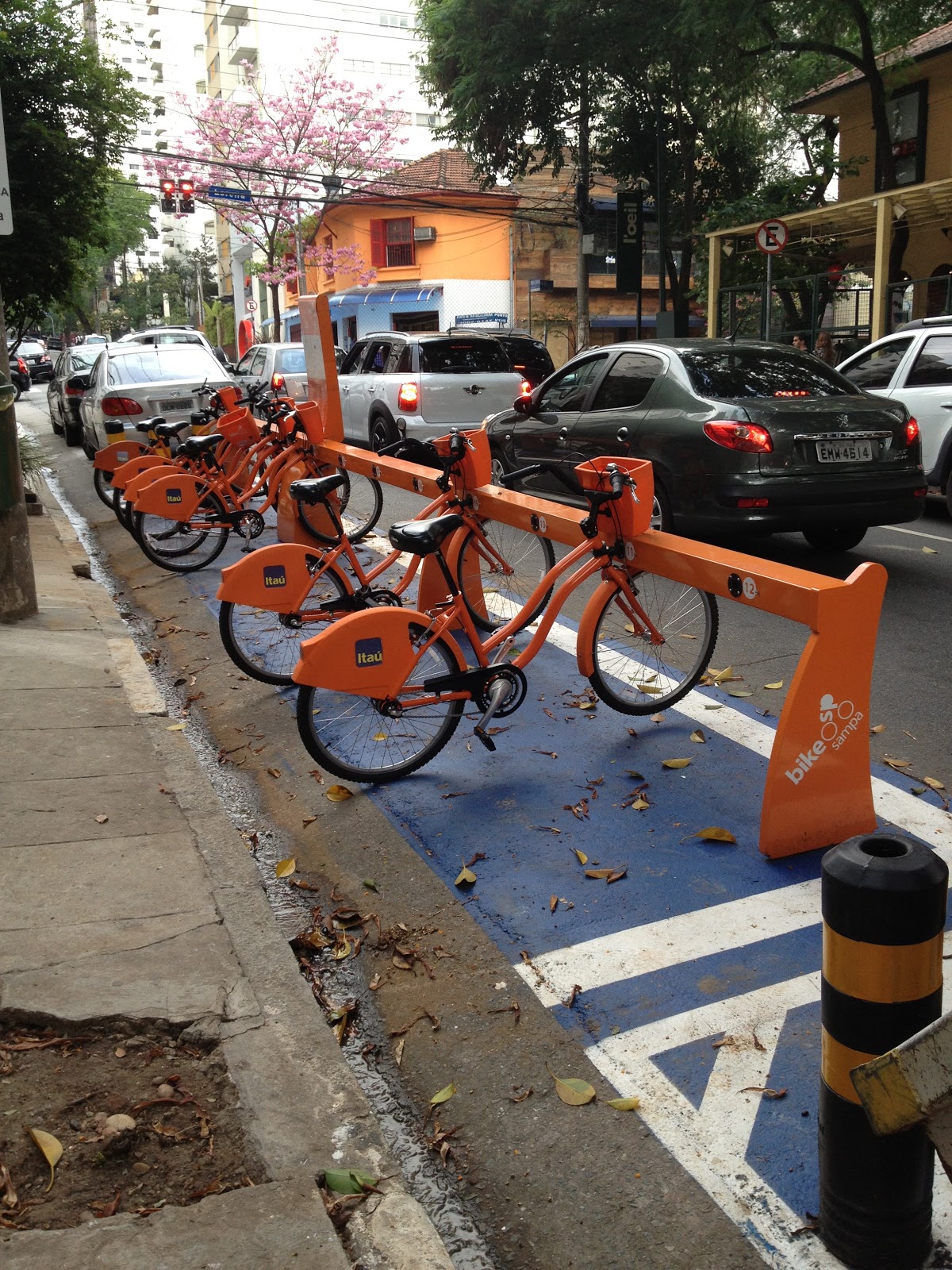
Now bicycle sharing is great, and I'd love to do it, but there are three things holing me back.
One, São Paulo traffic is insane and there is very little room on the too small streets (yes, São Paulo was never planned as a megalopolis).
Two, the district they are in, Jardins, is very hilly and getting anywhere on these one speed bikes is going to be a big challenge.
Three, there is no way I am venturing out on the streets (see number one) without a helmet which are, sadly, not provided.
Blogging will be erratic and Brazil-centric for a while (I am here all month as I conduct research and learn a little more Portuguese while on sabbatical).
Friday, November 2, 2012
In Praise of Prices
And a cautionary tale of trying to control them. Before getting all pedantic let's cut to the chase and point out two things about 'price gouging' now that the topic is all the rage (see here and here) given gas and other shortages in the NY/NJ area:
But the second point is not made in either linked article (well, article and radio story) which is that those that would end up with scarce and essential resources would disproportionately be the wealthier members of society. This is not new, Ferraris are scarce, gold is scarce, 20,000 square foot mansions are scarce, and so on. So even in the absence of disaster, this is how markets work - something we have known for a long time: markets are efficient but not 'fair.'
None of this solves the question of how we ration scarce resources in a time of crisis, however, and in such this is a lesson in both the power and limitations of free markets. The key, though, is that free markets do a lot better job than price controls. Price controls mean that, in large part, the lucky get resources and the unlucky do not.
Lines are a rationing mechanism, those with the most need are more willing to wait on line for hours upon hours, but they are terribly inefficient, that time is also a valuable resource where they could be doing more productive things. But prices, for their faults, will assure efficient distributions, will ration and will promote the speedy replenishment of resources. And the great thing about prices is that it takes no institutional control - all of the efficient rationing would take place immediately and naturally.
A crisis is not the time, I suppose one could say, to start worrying too much about the inequality prevalent in our society - it amplifies it and perhaps suggests we should be doing much more - but price controls only make a bad situation worse.
Now, there could potentially be hybrid solutions - the first two gallons of gas, say at reduced prices, but then whatever price the station wants to charge - but these take institutional control. It could be that low income folks can get vouchers for stuff, but that would be hard to implement in a crisis. In the end, despite their problems, prices are the first best solution.
1. Allowing prices to rise uncontrolled will act as a efficient allocation mechanism, doing away with shortages and assuring those whose valuation of the good is highest get it.
2. This has absolutely nothing to do with 'fairness' or 'equity' and it is very much the case that high valuations and income are highly correlated.
What, of course, is true is that I have just described free markets in general.
So now to the pedantic part. Here is Matt Yglesias making point number one:
The basic imperative to allocate goods efficiently doesn’t vanish in a storm or other crisis. If anything, it becomes more important. And price controls in an emergency have the same results as they do any other time: They lead to shortages and overconsumption. Letting merchants raise prices if they think customers will be willing to pay more isn’t a concession to greed. Rather, it creates much-needed incentives for people to think harder about what they really need and appropriately rewards vendors who manage their inventories well.The last part is a bit of a stretch, it is a windfall profit that vendors get but no more so than the seller of vitamins after a new study shows a daily dose vitamin Q will cause you to live forever not because they are brilliant inventory managers. But the basic idea is correct: prices are an efficient way to ration a scarce resource. The part about the vendor also missing the most important point, if gas prices are allowed to rise to market levels, imagine how much harder suppliers would try to get gas deliveries in, how much harder gas stations would work to get temporary power, and so on.
But the second point is not made in either linked article (well, article and radio story) which is that those that would end up with scarce and essential resources would disproportionately be the wealthier members of society. This is not new, Ferraris are scarce, gold is scarce, 20,000 square foot mansions are scarce, and so on. So even in the absence of disaster, this is how markets work - something we have known for a long time: markets are efficient but not 'fair.'
None of this solves the question of how we ration scarce resources in a time of crisis, however, and in such this is a lesson in both the power and limitations of free markets. The key, though, is that free markets do a lot better job than price controls. Price controls mean that, in large part, the lucky get resources and the unlucky do not.
Lines are a rationing mechanism, those with the most need are more willing to wait on line for hours upon hours, but they are terribly inefficient, that time is also a valuable resource where they could be doing more productive things. But prices, for their faults, will assure efficient distributions, will ration and will promote the speedy replenishment of resources. And the great thing about prices is that it takes no institutional control - all of the efficient rationing would take place immediately and naturally.
A crisis is not the time, I suppose one could say, to start worrying too much about the inequality prevalent in our society - it amplifies it and perhaps suggests we should be doing much more - but price controls only make a bad situation worse.
Now, there could potentially be hybrid solutions - the first two gallons of gas, say at reduced prices, but then whatever price the station wants to charge - but these take institutional control. It could be that low income folks can get vouchers for stuff, but that would be hard to implement in a crisis. In the end, despite their problems, prices are the first best solution.
Thursday, November 1, 2012
The Triumph of SF Over Detroit

It seems almost funny to think about a city that is now the capital of the high tech, information technology world as a blue-collar industrial place, but that is exactly what it was in the post WWII era. The San Francisco bay was ringed by giant shipyards, oil refineries, military bases and factories. The renaissance started in the 1970s, right about the beginning of the decline of Detroit, also a blue collar, industrial . So why has San Francisco prospered and Detroit suffered in the intervening years? Glaeser provides some insight:
But vast factories, such as Ford’s River Rouge, are kingdoms unto themselves. They don’t need the cities that surround them, and when economic conditions change, factories are relocated to lower-cost areas, such as the right-to-work states of the South and the developing world.Glaeser then goes on to talk about weather. Places with better weather have fared better in the post WWII era. One reason is that entrepreneurship has become more mobile as it becomes more service oriented and less capital intensive (or at least where the capital intensive activities are easier to do at an arms length) and so people are more apt to move to a place they enjoy living.
San Francisco’s manufacturing base, including its once- mighty shipyard at Hunter’s Point, also declined after World War II. But the city, unlike Detroit, was able to rebuild itself, because it had skills and entrepreneurship.
Detroit in its heyday was marvelously productive, but it was never education-intensive. In 1950, only 5 percent of the Detroit area’s adults had college degrees and that number had only increased to 9 percent by 1970. Wages were so good in the factories, why would anyone waste time in college? Nine percent of the San Francisco area’s adults had college degrees in 1950, and that number had doubled by 1970.
From 1940 to 2000, those places that started with slightly more education typically experienced far faster growth in human capital. By 2000, 44 percent of greater San Francisco had a bachelor’s degree, as opposed to 23 percent of adults in greater Detroit.
Informal skills, learned on the job and at the breakfast table, such as the talent and inclination to be an entrepreneur can be even more important for urban success. Detroit taught plenty of informal skills, especially around the assembly line, but its big companies didn’t inculcate entrepreneurship.
The middle managers of General Motors may have been superb cogs in a corporate machine, but they were not trained to start an electronic greeting company if things went wrong for GM. San Francisco had fewer dominant companies and consequently more entrepreneurs per capita. Entrepreneurs, such as Donald Fisher, who founded San Francisco’s the Gap, always play an outsize role in urban rebirth.
Skills enabled San Francisco to specialize in creating ideas, while Detroit remained a center of goods production. Measures of skill, such as the share of the population with a college degree, do a good job explaining the relative success of U.S. cities. Measures of entrepreneurship, such as having a lot of small companies, also predict employment growth.
But I think there is another factor, one that I think about a lot as a development economist. At the heyday of Detroit's auto industry and the power of the unions, you could have a very good middle class life as an auto worker. Because there were very good careers available for high school educated individuals, the incentives to go and get a college degree were lessened and, not surprisingly, few people did. I think the double whammy of this being less true for SF workers (supposition - I don't know this to be true) and the rise of both the UC and CSU systems (and the rise to prominence of Stanford University) created an environment with very different incentives.
Anyway, I was rooting heartily for the Giants, but did feel a little bad. I was hoping Detroit could take a game or two in Detroit to make the fans happy. I also feel a little guilty: I had only to wait half my life (I hope) to see the Giants win while my father, a Bostonian, had to wait most of his to see his beloved Red Sox win.
And, as an aside, my diverse sporting allegiances are explained by my formative years having been spent (in almost equal measure) in San Francisco, Madison, Wisconsin, and Portland while being raised by a London-born mother. In my earlier SF years, I was taken to many Giants games at Candlestick, then later after being transplanted to the midwest, the Badgers and Packers became central, and later the Blazers of the later 80s and early 90s were my passion. Finally, as a graduate student in a department almost completely made up of foreign students from Italy, Argentina, Brazil, Turkey, Chile and so on, I learned the true passion of the soccer fan and my allegiance to Arsenal was cemented.
So recent years have been very good: the rise of the Badgers from perennial dormat to regular top 25 team in both basketball and Football, the Super Bowls of the Packers, the World Series of the Giants, the success of the Blazers has been good - but we need an NBA championship - and the Arsenal (save for the most recent few years) have played attractive and successful soccer.
Is it any wonder then that Portland, Madison Wisconsin and SF have all prospered relatively in those years as well? There is one common denominator - me. Clearly there is a causal link between my presence and success. After all, OSU hired me and promptly won two national championships in baseball. I rest my case.
Subscribe to:
Posts (Atom)