From the Federal Reserve Bank of Cleveland (via the New York Times' Economix Blog) here is the increase in the wage premium for college degrees vs. high school diplomas over time:
Here is Economix's Catherine Rampell's break down of this net effect into bachelors, masters and doctorate degrees:
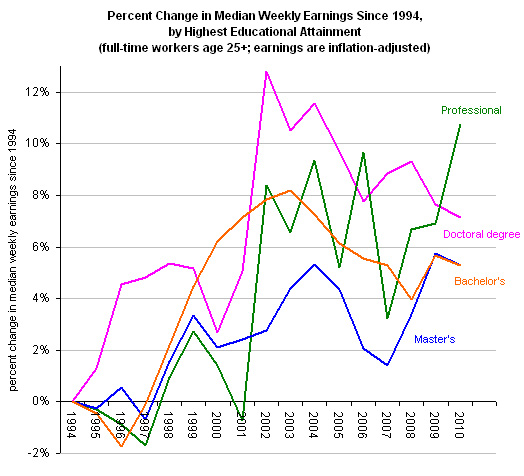
The story is the same, the payoff to a college degree of all sorts is still growing.
Showing posts with label education. Show all posts
Wednesday, January 11, 2012
Tuesday, May 31, 2011
A Lesson in Causality
From The Oregonian:
John Tapogna, president of economics consulting firm EcoNorthwest and a seasoned researcher of school spending statistics, said the prospects for Oregon schools to return to above-national-average spending -- or to feel they've shed the constant need to cut back offerings, jobs or both -- are dim.
The main reason Oregon spends less is that Oregonians earn less than the national average -- so they have less to spend. As a whole, Oregonians consistently contribute 4 percent of their collective income to public schools, he said.
Oregon's economy and per-capita income would have to grow faster than the nation's to make it natural for Oregonians to increase their spending on schools faster than the nation, he said. And that's unlikely, according to the state economist and others.
Now how could Oregon make resident incomes grow faster? I wonder...
Monday, March 7, 2011
Two Hard Truths About Incentive Pay for Teachers
Education research has found teacher quality to be the single biggest determinant of student success. However we also know that teacher quality is not predictable based on any observables - degrees, quality of schools, etc. Which is why there is such an emphasis on ex-post teacher evaluation and performance based incentives. It has to be after a teacher is on the job that their performance is evaluated and then there must be a mechanism to promote successful ones. This is all quite logical.
But before we rush headlong on incentive schemes and hiring/firing policies we must confront two inconvenient truths in education:
1. Teacher evaluation is very hard and the great hope of using value-added measures is not working very well in practice. The measure are unstable across years, tests and even, I am told from someone with intimate knowledge of the Chilean experiment, across sections of the same test.
2. Incentive schemes, at least in the US are not working.
Just something to think about apropos the new PPS teacher contract set to be ratified by the board tonight.
But before we rush headlong on incentive schemes and hiring/firing policies we must confront two inconvenient truths in education:
1. Teacher evaluation is very hard and the great hope of using value-added measures is not working very well in practice. The measure are unstable across years, tests and even, I am told from someone with intimate knowledge of the Chilean experiment, across sections of the same test.
2. Incentive schemes, at least in the US are not working.
Just something to think about apropos the new PPS teacher contract set to be ratified by the board tonight.
Tuesday, January 4, 2011
The Value of Teacher Quality
It is not news that teacher quality is the most important factor in an effective classroom, but Eric Hanushek has a new paper where he attempts to place a value on quality and the numbers are very big. This, I suppose, speaks to the debate about pay for performance. If the actual value of a good over a not-so-good teacher is so large then perhaps we should have sizable rewards for good teaching.
Here is the abstract [HT: Greg Mankiw]:
There is a big problem however: how do you measure a good teacher, or even more problematically, how do you measure good performance on an annual basis? In Brazil I heard about experiments in Chile with so-called value added measures of teacher quality that were terrible disappointments. There is a complete lack of consistency across different tests and even within sections of the same test. In other word, when they gave a standardized math test to students at the beginning and at the end of a year, some students improved markedly on one section of the test but did not on the other and vice-versa. So there was no clear way to rank classrooms in terms of the value added by the teacher. The same was true across tests (Spanish and Math, say). So how can you say one teacher is better than others? You can't.
We are still a long way off from the answers.
Here is the abstract [HT: Greg Mankiw]:
Most analyses of teacher quality end without any assessment of the economic value of altered teacher quality. This paper combines information about teacher effectiveness with the economic impact of higher achievement. It begins with an overview of what is known about the relationship between teacher quality and student achievement. This provides the basis for consideration of the derived demand for teachers that comes from their impact on economic outcomes. Alternative valuation methods are based on the impact of increased achievement on individual earnings and on the impact of low teacher effectiveness on economic growth through aggregate achievement. A teacher one standard deviation above the mean effectiveness annually generates marginal gains of over $400,000 in present value of student future earnings with a class size of 20 and proportionately higher with larger class sizes. Alternatively, replacing the bottom 5-8 percent of teachers with average teachers could move the U.S. near the top of international math and science rankings with a present value of $100 trillion.
There is a big problem however: how do you measure a good teacher, or even more problematically, how do you measure good performance on an annual basis? In Brazil I heard about experiments in Chile with so-called value added measures of teacher quality that were terrible disappointments. There is a complete lack of consistency across different tests and even within sections of the same test. In other word, when they gave a standardized math test to students at the beginning and at the end of a year, some students improved markedly on one section of the test but did not on the other and vice-versa. So there was no clear way to rank classrooms in terms of the value added by the teacher. The same was true across tests (Spanish and Math, say). So how can you say one teacher is better than others? You can't.
We are still a long way off from the answers.
Tuesday, December 7, 2010
Education around the World
One thing that really struck me, as I was sitting in a conference on education in São Paulo, was how similar is the debate about education reform in low, middle and high income countries. Questions of accountability, standardized testing, incentives are just as relevant there as here and we are all struggling to find the right way forward.
For the US, the problem is clear:
The answers are not.
For the US, the problem is clear:
The answers are not.
Wednesday, November 17, 2010
Do Better Students Make Better Teachers?
The Oregonian/Jim Springhetti
On Sunday, The Oregonian published a massively long op-ed piece by two McKinsey consultants arguing that the US has a big problem in the fact that out very top students are not going into teaching (K-12). They spend a long time describing how poor the US is at attracting top college students to go into teaching relative to other countries that have top performing education systems. They spend a long time discussing the ways that the US could go about fixing this problem and how it is not a daunting as it seems.
But throughout the entire article is the assumption, left unexamined until the last paragraph despite its massive length, that better students make better teachers. The problem with this is that the answer appears to be no.
Here is a passage from a New York Times Magazine article on what makes a good teacher:
But what makes a good teacher? There have been many quests for the one essential trait, and they have all come up empty-handed. Among the factors that do not predict whether a teacher will succeed: a graduate-school degree, a high score on the SAT, an extroverted personality, politeness, confidence, warmth, enthusiasm and having passed the teacher-certification exam on the first try.
This is a pretty good summary of the (good) evidence: things that we can observe about teachers (where they went to school, their certifications, their academic success) are not good predictors of being effective teachers in the classroom.
Particularly gauling is the last paragraph of the Oregonian Op-Ed which finally gets around to trying to make the case that recruiting better students is critical to improve educational performance:
Some U.S. researchers say there's little evidence that teachers with stronger academic backgrounds produce higher student achievement, but this conclusion is starkly at odds with the experiences of Singapore, Finland and South Korea. Our McKinsey colleagues have studied more than 50 school systems around the world and have never seen a nation achieve or sustain world-class educational performance without drawing its teachers from the top third of their class. Should we really bet our children's future on the possibility that our country might be the exception?
Er...those 'some U.S. researchers' are the ones that very carefully try and isolate the causal link. Unlike McKinsey and Co. that appears to have no concept of the problem confusing correlation with causality. We don't know the counterfactual and cannot, I repeat, CANNOT make any causal statement about the effectiveness of teachers from this observed correlation.
Okay now that I have vented, what interests me even more than the bad scholarship is the essential question this raises: do we really want our best and brightest becoming K-12 teachers? I am not sure it takes a person with an amazing aptitude for astro-physics to teach a second grader how to add. I think I'd rather have the astro-physics prodigy go off and do astro-physics. Or a talented biologist teaching kids about chrysalis instead of finding a cure for cancer. Or a exceptional engineer teaching Phys. Ed. rather than solving the energy problem. In other words, rather than viewing the current state of affairs in US education as a failure, it is quite possible that this represents a strength of how free labor markets are in the country. Perhaps we have the comparative advantage equation all figured out - channeling talent where it is relatively most effective (okay, if we ignore investment bankers).
This is likely to be seen as provocative, but as an economist I don't see it that way, when I think about my own kids, I am not sure it matters to me if their grade school teachers scored 800 on the math section of the SAT, but it matter a lot to me if they can connect with students, adjust to their different needs and inspire them. And, by the way, I am the son of a public high school english teacher who went to Stanford and is pretty damn smart, so I am not dismissing intelligence, rather making a case for other attributes that may matter as much or more.
And the every widening skill premium accounts for some of what has been the declining relative pay for teachers. With all the productivity enhancing technology out in the world the difference between productivity in areas where technology makes a big impact and areas where it doesn't (teaching) means that relative returns are going to diverge (see: cost disease). This is true for my profession as well - economists in the private sector have wage gains that far exceed those of us that chose education.
By the way, that NY Times Magazine article is about whether we can make good and effective teachers or are some people just born to be good and we can't do much. It is very interesting and I don't know the answer, but I suspect that both are important. Good training can make anyone better but some have a knack and some don't. Which again to an economist is not a mark of shame, but simply a skill/requirement mismatch.
This is the lesson of comparative advantage: we are all relatively good at something.
Wednesday, October 13, 2010
Education Reform News and an Appeal for Evidence-Based Policy
Today brings news of the education reform movements superstar Michelle Rhee's ouster as chief of the DC public schools and of the PPS school board's decision to accept, finally, the high school redesign plan of Super Carole Smith.
In DC, a new mayor is bringing on his own team but promises to continue the reforms Rhee began, though it must be assumed that they will not continue apace. In Portland, after a process that looked suspiciously like trying out competing redesigns to see which one would have the weakest dissent, it was finally determined that Marshall High would be the one to close despite the promising gains in student achievement made there recently.
I have no specific gripe with the Portland high school redesign - it may well be that this is the best thing for the district to do - what concerns me is that we don't really have any idea what the best thing to do is. And thus, every few years the powers that be decide that something different has to be done. First it is small schools: they are the answer to all that is wrong with Portland's low performing high schools. A few short years later it is large comprehensive schools that are the answer. The truth is no one knows what the right answer is, and confident statements by the superintendent about doing what is right are naive. What I am pretty sure of is that constant re-jiggering of the schools is not optimal for anything except continued low performance.
And this is the problem, policy is ahead of the science but this doesn't lead to more subtle policy, rather more hubris-led big policy. I suppose this is part of the politics of the thing. Rhee for example, clearly relished the spotlight and was a hard-charger toward reform. I think the flexibility she won for the district to be more proactive with both good and bad teachers is a good thing. But the truth about teacher incentives is that that are not a panacea - in fact studies have shown only modest improvements with incentives. This is not really surprising, most teachers are doing their very best and working devilishly hard every day to get their students to succeed. I think it is more about getting talented teachers to take up the profession and moving those less naturally adept into other professions. To do so, I think it is schools of education that need to start to get more proactive and serious about evaluating their students. But I digress.
What is needed is a little humility and a desire to learn what works on the part of policy makers. PPS, for example, is sitting on a mountain of incredibly valuable data, but as far as I am aware no real study of this data is being done. And yet major policy is being made. As I have said before, PPS has a wonderful opportunity to use its transfer lottery as a nice natural experiment to begin to understand what happens to students that are put into different educational situations. But alas, what we get are over-confident statements about how this new approach will bring about the desired results.
I hope so, but we shouldn't be making policy in the dark.
In DC, a new mayor is bringing on his own team but promises to continue the reforms Rhee began, though it must be assumed that they will not continue apace. In Portland, after a process that looked suspiciously like trying out competing redesigns to see which one would have the weakest dissent, it was finally determined that Marshall High would be the one to close despite the promising gains in student achievement made there recently.
I have no specific gripe with the Portland high school redesign - it may well be that this is the best thing for the district to do - what concerns me is that we don't really have any idea what the best thing to do is. And thus, every few years the powers that be decide that something different has to be done. First it is small schools: they are the answer to all that is wrong with Portland's low performing high schools. A few short years later it is large comprehensive schools that are the answer. The truth is no one knows what the right answer is, and confident statements by the superintendent about doing what is right are naive. What I am pretty sure of is that constant re-jiggering of the schools is not optimal for anything except continued low performance.
And this is the problem, policy is ahead of the science but this doesn't lead to more subtle policy, rather more hubris-led big policy. I suppose this is part of the politics of the thing. Rhee for example, clearly relished the spotlight and was a hard-charger toward reform. I think the flexibility she won for the district to be more proactive with both good and bad teachers is a good thing. But the truth about teacher incentives is that that are not a panacea - in fact studies have shown only modest improvements with incentives. This is not really surprising, most teachers are doing their very best and working devilishly hard every day to get their students to succeed. I think it is more about getting talented teachers to take up the profession and moving those less naturally adept into other professions. To do so, I think it is schools of education that need to start to get more proactive and serious about evaluating their students. But I digress.
What is needed is a little humility and a desire to learn what works on the part of policy makers. PPS, for example, is sitting on a mountain of incredibly valuable data, but as far as I am aware no real study of this data is being done. And yet major policy is being made. As I have said before, PPS has a wonderful opportunity to use its transfer lottery as a nice natural experiment to begin to understand what happens to students that are put into different educational situations. But alas, what we get are over-confident statements about how this new approach will bring about the desired results.
I hope so, but we shouldn't be making policy in the dark.
Tuesday, October 5, 2010
Paying Kids for Grades
Hey OPB listeners, check out what out erstwhile Central Oregon Bureau Chief, Ethan Lindsey, is doing these days: Freakonomics Radio! Cool.
Alerted to this fact, I see that one of the first stories is on the idea of paying kids for grades to improve educational performance. Sounds like a no brainer, right? Put the incentive right at the crux of the problem: learning is hard work so motivate kids to work harder.
Turns out this only sometimes works. The reasons are still speculative but the most interesting theory is that only some kids 'know the production function.' In other words, only some kids understand what they have to do to get better grades. For them it is not just about effort but about learning how to learn.
Give lazy kids from educated middle class households money for As and it works great. Give lower class kids from less-well educated households money and it often doesn't work out so well, because they don't understand what they need to do to get an A.
Sometimes money isn't the only answer.
Wednesday, September 8, 2010
Back to School and the Economics of Education
While Oregon's public universities are still a couple of weeks away from the start of Fall term, most K-12 districts open this week, so it is a good time to remind ourselves of one reason we invest heavily in education: it is a smart thing to do.
From the Bureau of Labor Statistics [HT: Wall Street Journal]:
There is also lower rates of unemployment among the more educated:
And higher pay:
And, don't forget, you can now get an Oregon State economics BA or BS entirely on-line. It is never too late!
From the Bureau of Labor Statistics [HT: Wall Street Journal]:
All of the increase in employment over the past two decades has been among workers who have taken at least some college classes or who have associate or bachelor's degrees—and mostly among workers with bachelor's degrees. The number of these college-educated workers has increased almost every year. Over the 1992–2009 period, the number of college-educated workers increased from 27 million to 44 million. In contrast, the number of employed people with only a high school diploma or without a high school diploma has remained steady or decreased.
There is also lower rates of unemployment among the more educated:
And higher pay:
If you think what people say about higher education leading to higher earnings is a cliché, you might want to consider that sometimes clichés are true. In 2009, the median weekly earnings of workers with bachelor's degrees were $1,137. This amount is 1.8 times the average amount earned by those with only a high school diploma, and 2.5 times the earnings of high school dropouts.
And, don't forget, you can now get an Oregon State economics BA or BS entirely on-line. It is never too late!
Wednesday, July 28, 2010
Each Year of Education Matters
States like Oregon are in a fiscal mess as a result of the recession and are being forced to go through some 'belt tightening.' In Oregon, since the state general fund is vital to education funding, this means some pretty severe cuts to K-12 education.
But does it really matter that much if a kid has a year or two of substandard education from such budget cuts through such measures as reduced instructional days or larger class sizes?
Yes.
New research by a gaggle of economists has found that the quality of a child's kindergarden itself has lifelong implications for children. Here is The New York Times' article and here is a follow up blog post. From the article:
This is, frankly, a staggering result. When I have talked about the Obama administration's emphasis on collecting and examining longitudinal eductation data I tell them that it represents a way of moving beyond test scores as measures of tecaher and school effectiveness. I emphasize that it allows us to focus on outcomes not test scores. This is a perfect example. I also emphasize that it is important to try reforms so that we can tell what works. In this case it is the amazing STAR study done in Tennessee. As I have written about before both here and in The Oregonian the STAR study provides a unique opportunity to study the effect of class size - which was found to have real and important impacts. But, as this study emphasizes, it is the teachers themselves that are the most important factor by far (and as I have said it is impossible to predict success in the classroom of potential teachers so it is important to have a way of rewarding the good ones and discouraging the bad ones).
Anyway, what this study says is that kindergarden itself has lifelong consequences for kids and it is not hard to imagine that this is true, to varying degrees, of each individual year of education. So these occasional budget slashing years are doing irreparable harm to our kids. And as the follow up blog post emphasizes, unlike a lot of other effects, the effect identified in this paper (in terms of adult outcomes) are the same for rich and poor kids. So everyone should be concerned.
And if this isn't a clarion call for a permanent rainy-day fund, I don't know what is.
But does it really matter that much if a kid has a year or two of substandard education from such budget cuts through such measures as reduced instructional days or larger class sizes?
Yes.
New research by a gaggle of economists has found that the quality of a child's kindergarden itself has lifelong implications for children. Here is The New York Times' article and here is a follow up blog post. From the article:
How much do your kindergarten teacher and classmates affect the rest of your life?
Economists have generally thought that the answer was not much. Great teachers and early childhood programs can have a big short-term effect. But the impact tends to fade. By junior high and high school, children who had excellent early schooling do little better on tests than similar children who did not — which raises the demoralizing question of how much of a difference schools and teachers can make.
There has always been one major caveat, however, to the research on the fade-out effect. It was based mainly on test scores, not on a broader set of measures, like a child’s health or eventual earnings. As Raj Chetty, a Harvard economist, says: “We don’t really care about test scores. We care about adult outcomes.”
Early this year, Mr. Chetty and five other researchers set out to fill this void. They examined the life paths of almost 12,000 children who had been part of a well-known education experiment in Tennessee in the 1980s. The children are now about 30, well started on their adult lives.
On Tuesday, Mr. Chetty presented the findings — not yet peer-reviewed — at an academic conference in Cambridge, Mass. They’re fairly explosive.
Just as in other studies, the Tennessee experiment found that some teachers were able to help students learn vastly more than other teachers. And just as in other studies, the effect largely disappeared by junior high, based on test scores. Yet when Mr. Chetty and his colleagues took another look at the students in adulthood, they discovered that the legacy of kindergarten had re-emerged.
Students who had learned much more in kindergarten were more likely to go to college than students with otherwise similar backgrounds. Students who learned more were also less likely to become single parents. As adults, they were more likely to be saving for retirement. Perhaps most striking, they were earning more.
All else equal, they were making about an extra $100 a year at age 27 for every percentile they had moved up the test-score distribution over the course of kindergarten. A student who went from average to the 60th percentile — a typical jump for a 5-year-old with a good teacher — could expect to make about $1,000 more a year at age 27 than a student who remained at the average. Over time, the effect seems to grow, too.
...
The crucial problem the study had to solve was the old causation-correlation problem. Are children who do well on kindergarten tests destined to do better in life, based on who they are? Or are their teacher and classmates changing them?
The Tennessee experiment, known as Project Star, offered a chance to answer these questions because it randomly assigned students to a kindergarten class. As a result, the classes had fairly similar socioeconomic mixes of students and could be expected to perform similarly on the tests given at the end of kindergarten.
Yet they didn’t. Some classes did far better than others. The differences were too big to be explained by randomness. (Similarly, when the researchers looked at entering and exiting test scores in first, second and third grades, they found that some classes made much more progress than others.)
Class size — which was the impetus of Project Star — evidently played some role. Classes with 13 to 17 students did better than classes with 22 to 25. Peers also seem to matter. In classes with a somewhat higher average socioeconomic status, all the students tended to do a little better.
But neither of these factors came close to explaining the variation in class performance. So another cause seemed to be the explanation: teachers.
Some are highly effective. Some are not. And the differences can affect students for years to come.
This is, frankly, a staggering result. When I have talked about the Obama administration's emphasis on collecting and examining longitudinal eductation data I tell them that it represents a way of moving beyond test scores as measures of tecaher and school effectiveness. I emphasize that it allows us to focus on outcomes not test scores. This is a perfect example. I also emphasize that it is important to try reforms so that we can tell what works. In this case it is the amazing STAR study done in Tennessee. As I have written about before both here and in The Oregonian the STAR study provides a unique opportunity to study the effect of class size - which was found to have real and important impacts. But, as this study emphasizes, it is the teachers themselves that are the most important factor by far (and as I have said it is impossible to predict success in the classroom of potential teachers so it is important to have a way of rewarding the good ones and discouraging the bad ones).
Anyway, what this study says is that kindergarden itself has lifelong consequences for kids and it is not hard to imagine that this is true, to varying degrees, of each individual year of education. So these occasional budget slashing years are doing irreparable harm to our kids. And as the follow up blog post emphasizes, unlike a lot of other effects, the effect identified in this paper (in terms of adult outcomes) are the same for rich and poor kids. So everyone should be concerned.
And if this isn't a clarion call for a permanent rainy-day fund, I don't know what is.
Wednesday, May 5, 2010
Sigh
Saying it is sure to lose, Oregon quits contest for federal school innovation money
By Betsy Hammond, The Oregonian
Oregon dropped out of competition for a federal Race to the Top school innovation grant Tuesday because the state is too far behind the rest of the pack to have a shot at winning, Oregon Gov. Ted Kulongoski said Tuesday.
Oregon needs to go back to the drawing board on basics such as how to turn around chronically low-performing schools and how to include student achievement growth when evaluating teachers and principals, he said.
What's more, Kulongoski said, Oregon's nearly 200 district school district superintendents and teachers unions aren't interested in gunning for the federal grant, which could have brought $175 million to Oregon but would have required big changes, including more state say over schools.
Nearly 7 1/2 years into his eight years as the state's top official, the governor now says he will convene a group of education advocates and other interested leaders to craft a package of school reform policies for the 2011 Legislature to act on.
"Simply put, Oregon needs to build a stronger foundation for K-12 reform," he wrote in a letter to U.S. Education Secretary Arne Duncan to announce that Oregon has quit the federal contest.
Oregon was one of 40 states that applied in the first round of competition for a share of $4 billion in federal funding. States had to show they have already improved student achievement and offer specific plans to fix low-achieving schools, raise academic standards, use data to improve instruction, and strengthen teacher evaluation.
Oregon's proposal, written by more than 100 educators and school advocates after months of work, was graded seventh worst. The state was judged to have some strong areas, but the application was deemed vague and the state's progress to date too tepid. The state was dinged for having too little authority over low-performing schools, and raters weren't convinced that student growth would be used to help evaluate and reward teachers.
...
Becca Uherbelau, spokeswoman for the state teachers union, the Oregon Education Association, said dropping out was smart because Race to the Top officials wanted a cookie-cutter reform plan that didn't fit Oregon.
But she said the collaboration among public school leaders, universities, state officials and others to design the state's application was a healthy development that will continue.
"Oregon is in a good place to move forward and improve achievement for all students because of that collaborative partnership and coming together," she said. "We remain committed to working together to develop sound education policy," which should revolve primarily around better funding for schools."
Sue Levin, executive director of Stand for Children, a school advocacy group made up mainly of parents, said Oregon's decision not to apply the decision was a "sad" acknowledgment of how little the state has done to improve education.
"Oregonians are still in denial about the troubles of our educational system," Levin said. "In other states, either the governor or the state superintendent of public instruction or legislative leaders are serious, committed champions for education reform who have decided that is going to be their issue and they are going to tackle it. That hasn't been the case in Oregon since the 1990s. Absent that ... you can't just whip it up in three months.
"Hopefully this is a call to action for Oregon parents," Levin said. "I think there are folks around this state who are ready to have the difficult conversations, and they are going to be difficult conversations, about how we are going to educate all our children."
I don't think they want cookie cutter reforms but want evidence-based policy: so they want states to collect and analyze data, create real performance measures and have in place incentive mechanisms to encourage good teachers, schools and districts. Not all of this is easy, nor is the evaluation mechanism obvious and so on, but to give up is unforgivable.
Thursday, April 22, 2010
The Oregonian and Oregon Education Leadership
I was gratified to see The Oregonian editorial board publicly question the state leadership of K-12 education. I have been dismayed by what appears to be a lack of strong leadership and, particularly, well-qualified leadership.
Now, I know little of Susan Castillo and therefore don't feel in a position to judge her. She certainly seems almost anonymous and has no formal qualifications for the job - but neither one means she does not do the job well. Many effective leaders are quiet consensus builders and, quite frankly, the research I have seen from the education research establishment is generally pretty dismal so an advanced degree in education is not necessarily a bonus. But given the startlingly poor showing of the state in the Race for the Top grant competition, it suggests that much more forceful and effective leadership is necessary. Yes, there are a lot of legitimate concerns about Race for the Top, but money is money and the state's poorly funded K-12 education system could use all the help it can get. Besides, if there is one new welcome trend in education it is the move toward evidence based policy, so we should not be afraid of bad ideas sticking.
The Oregonian identifies a major problem: if we are only paying this position 65% or so of a competitive wage, it is going to be hard to attract a talented leader. I think they are right to call for a substantial increase in the wage of the Superintendent position.
Now, I know little of Susan Castillo and therefore don't feel in a position to judge her. She certainly seems almost anonymous and has no formal qualifications for the job - but neither one means she does not do the job well. Many effective leaders are quiet consensus builders and, quite frankly, the research I have seen from the education research establishment is generally pretty dismal so an advanced degree in education is not necessarily a bonus. But given the startlingly poor showing of the state in the Race for the Top grant competition, it suggests that much more forceful and effective leadership is necessary. Yes, there are a lot of legitimate concerns about Race for the Top, but money is money and the state's poorly funded K-12 education system could use all the help it can get. Besides, if there is one new welcome trend in education it is the move toward evidence based policy, so we should not be afraid of bad ideas sticking.
The Oregonian identifies a major problem: if we are only paying this position 65% or so of a competitive wage, it is going to be hard to attract a talented leader. I think they are right to call for a substantial increase in the wage of the Superintendent position.
Monday, April 5, 2010
Oregon Education
The Oregonian had a scathing editorial this weekend about the states sorry attempt at 'Race for the Top' funds. One wonders why there is not more heat on Susan Castillo, the mostly under the radar State Superintendent of Public Instruction? The Oregonian does not even mention her name - why not? Should there be? I don't know enough to say, but one wonders why there is not more talk about her role in this process. I do know that Race to the Top includes lots of money for data collection and analysis and that Oregon is collecting, but were is the analysis? I would like to know more about all this before election time...ah, but wait, we don't have a press corps anymore! So will all those bloggers who cheer the demise of the the mainstream media please start reporting...?
Betsy Hammond, are you listening, can you tell us what is going on behind the scenes?
In a similar vein, PPS is going full steam on high school restructuring knowing almost nothing really about the effects of small vs. big schools. A lot of good sounding sound bite bromides are not enough. I have a suggestion: take a look at all of the school transfer lottery winners and losers over the last ten years and see if the winners did systematically better than the losers when they switched form smaller to bigger schools. There are a whole host of residual problems with a study like this, but it would at lest give us a sense about school effects vs. socio-economic and other effects. Heck, give me the data and I'll do it for you - free.
Betsy Hammond, are you listening, can you tell us what is going on behind the scenes?
In a similar vein, PPS is going full steam on high school restructuring knowing almost nothing really about the effects of small vs. big schools. A lot of good sounding sound bite bromides are not enough. I have a suggestion: take a look at all of the school transfer lottery winners and losers over the last ten years and see if the winners did systematically better than the losers when they switched form smaller to bigger schools. There are a whole host of residual problems with a study like this, but it would at lest give us a sense about school effects vs. socio-economic and other effects. Heck, give me the data and I'll do it for you - free.
Wednesday, December 2, 2009
Education Causes Growth
Two new papers by Hanushek and Woessmann provide powerful new evidence of the causal link between cognitive skills and economic growth:
Eric A. Hanushek, Ludger Woessmann:
Do Better Schools Lead to More Growth? Cognitive Skills, Economic Outcomes, and Causation
Abstract:
We investigate whether a causal interpretation of the robust association between cognitive skills and economic growth is appropriate and whether cross-country evidence supports a case for the economic benefits of effective school policy. We develop a new common metric that allows tracking student achievement across countries, over time, and along the within-country distribution. Extensive sensitivity analyses of cross-country growth regressions generate remarkably stable results across specifications, time periods, and country samples. In addressing causality, we find, first, significant growth effects of cognitive skills when instrumented by institutional features of school systems. Second, home-country cognitive-skill levels strongly affect the earnings of immigrants on the U.S. labor market in a difference-in-differences model that compares home-educated to U.S.-educated immigrants from the same country of origin. Third, countries that improved their cognitive skills over time experienced relative increases in their growth paths. From a policy perspective, the shares of basic literates and high performers have independent significant effects on growth, and the estimates suggest that the high-performer effect is larger in poorer countries.
http://ftp.iza.org/dp4575.pdf
IZA DP No. 4576
Eric A. Hanushek, Ludger Woessmann:
Schooling, Cognitive Skills, and the Latin American Growth Puzzle
Abstract:
Economic development in Latin America has trailed most other world regions over the past four decades despite its relatively high initial development and school attainment levels. This puzzle can be resolved by considering the actual learning as expressed in tests of cognitive skills, on which Latin American countries consistently perform at the bottom. In growth models estimated across world regions, these low levels of cognitive skills can account for the poor growth performance of Latin America. Given the limitations of worldwide tests in discriminating performance at low levels, we also introduce measures from two regional tests designed to measure performance for all Latin American countries with internationally comparable income data. Our growth analysis using these data confirms the significant effects of cognitive skills on intra-regional variations. Splicing the new regional tests into the worldwide tests, we also confirm this effect in extended worldwide regression! s, although it appears somewhat smaller in the regional Latin American data than in the worldwide data.
http://ftp.iza.org/dp4576.pdf
Thursday, November 5, 2009
Education and Democracy
From Ed Glaeser writing in The New York Times:
Glaeser:
Update, I had a busy morning, so I could not add my own two cents until now, but I am not entirely convinced abut the chain of causality. What interests me is whether countries who are experiencing vast expansions in education are finding their democracies stabilizing. Anecdotally for Glaeser's example, Argentina, the answer appears to be no. The differences between Argentina's and Brazil's democracies are quite stark. Argentina's democracy is, to my mind, immature, while Brazil, after an unfortunate period of dictatorship has developed quite a mature and stable democracy. In these data, Argentina is well above Brazil in 1960 in terms of average years of education and remains so today though both have doubled. So perhaps it has more to do with INSTITUTIONS (of which education is a part) is what is really important. Perhaps good education is just a proxy for good institutions (laws, courts, bureaucracies, etc.)
Glaeser:
One way to read the graph is that there are basically no countries with very low levels of education that have managed to be democratic over the long term, and almost every country with a high level of education has remained a stable democracy.
Thomas Jefferson wrote that “if a nation expects to be ignorant and free, in a state of civilization, it expects what never was and never will be.” In 1960, 36 nations had less than 1.74 years of schooling (which happens to be the level that Afghanistan has today). Of those 36 countries, only two — India and Botswana — managed to have average democracy scores above 4.2.
Out of the 19 countries in this sample with more than 5.3 years of schooling (the current level in Iran) in 1960, 17 have average democracy scores above 7.9. Fifteen of these have been perfectly democratic, at least by the standards of Polity IV. Only Poland and Hungary were dictatorships, and one can certainly argue that those places would have been democracies in 1960s if it were not for Soviet troops.
But in the middle ranges of education, between two and five years on average, almost anything goes.
Some places, like Costa Rica and Italy, have been extremely democratic, while others, like Kuwait and Paraguay, have not. Iraq falls into this category today, which suggests a fair amount of uncertainty about that country’s political future.
Why do I think that the chain of causality runs from education to democracy rather than the reverse? Democracy in 1960 is essentially uncorrelated with subsequent growth in the levels of education. Education in 1960, on the other hand, does an extremely good job of predicting increases in democracy.
The ability of education to predict the durability of democracy is well illustrated by the paths of former Communist bloc countries. Initially well-educated places, like the Czech Republic and Poland, have managed to transition toward being well-governed republics. Poorly educated places have not.
Why is there a connection between human capital and freedom?
Giacomo Ponzetto, Andrei Shleifer and I have argued that the connection reflects the ability of educated people to organize and fight collaboratively.
Dictators provide strong incentives for the ruling clique; democracies provide more modest benefits for everyone else. For democracy to beat dictatorship, the dispersed population needs to have the skills and motivation to work collaboratively to defeat dictatorial coups and executive aggrandizement.
Education teaches skills, like reading and writing, that enable people to work collaboratively. At younger grades, teachers spend a lot of time teaching children how to get along. In the United States, education is strongly linked to civic engagement and membership in social groups. The ability to work together enables the defense of democracy.
Update, I had a busy morning, so I could not add my own two cents until now, but I am not entirely convinced abut the chain of causality. What interests me is whether countries who are experiencing vast expansions in education are finding their democracies stabilizing. Anecdotally for Glaeser's example, Argentina, the answer appears to be no. The differences between Argentina's and Brazil's democracies are quite stark. Argentina's democracy is, to my mind, immature, while Brazil, after an unfortunate period of dictatorship has developed quite a mature and stable democracy. In these data, Argentina is well above Brazil in 1960 in terms of average years of education and remains so today though both have doubled. So perhaps it has more to do with INSTITUTIONS (of which education is a part) is what is really important. Perhaps good education is just a proxy for good institutions (laws, courts, bureaucracies, etc.)
Tuesday, November 3, 2009
Eco-nomics: The Trouble with Picking the Winners
Thomas Boyd/The Oregonian
This story in The Oregonian on Sunday about how the cost of the green energy tax credits are much higher than have been presented and how millions of dollars have gone to failed companies illustrates something that I have been arguing for a long time now to anyone who will listen: trying to create a green energy economy in Oregon is a mug's game. What will be the best technology: wind, wave, solar, geothermal, something else? Which companies are going to come out as leaders in the future? The answers to these questions are far from clear so trying to read the tea leaves and throwing hundreds of millions of dollars at a wall to see what sticks is not necessarily a good idea.
I am not against all government incentives, but the best investment the state could make if it really wants to promote economic growth in the state, green energy or otherwise, is in education, and if it is serious about a green energy economy, investing in research universities seems about as safe a bet as there is. You get research and technology spillovers that are centered in the state and you educate and train a new generation of entrepreneurs and workers to take those new technologies and run with them.
It seems that in Oregon these days the balance is out of whack...
Wednesday, October 14, 2009
Public Education Funding in Oregon
Sigh... From The Oregonian: In class size, Oregon ranks No. 49
Should We Care? This is one of the biggest debates in labor/education economics:
My reading of the literature is that for traditionally disadvantaged individuals (e.g., low income US and developing countries) it matters more than for non-disadvantaged students - for whom it might not matter much at all. Overall, however, the mass of evidence seems to pretty clearly support the idea that large classes are detrimental to student achievement. But, as always, much more work needs to be done.
A thought: if Novel H1N1 is bad this year with significant absences, might this provide a natural experiment to study the class size effect in Oregon schools?
Monday, July 27, 2009
Is Oregon a Business Friendly State?
Yes, according to CNBC. Oregon comes in #18 in their rankling of states, and it would be higher if not for the terrible state of the state's economy and the horrendous state of the state education system. It is 20th in 'cost of doing business', 16th in 'access to capital' and 26th in 'business friendliness', 19th in 'technology and innovation' and 14th in 'transportation and infrastructure'.What is troubling, however, is that the ranking of the state's education system has dropped from an already bad 29th in 2008 to 37th in 2009. And the fact that this is included in a "Top States for Business" ranking shows just how much education is important for business and the economy - not just for individuals.
Here is what CNBC has to say about education:
Education and business go hand in hand. Not only do companies want to draw from an educated pool of workers, they want to offer their employees a great place to raise a family. Higher education institutions offer companies a source to recruit new talent, as well as a partner in research and development. We looked at traditional measures of K-12 education including test scores, class size and spending.
And here are the education rankings. Hey, at least we are not Mississippi....yet.
Monday, June 8, 2009
Tuesday, February 24, 2009
Early School Closures and Economic Growth
Yesterday, I cited research from Maryland that shows that the loss of school days has a measurable impact on performance on aptitude tests. There is also a very strong link between scores on aptitude tests and economic growth. Below is a graph from an article by Eric Hanushek, perhaps the leading expert on the economics of education, and co-authors:


Though a measure of years of schooling has a weak impact on growth this is largely due to the fact that years of schooling and education are not the same thing (for many reasons like the fact that grade repetition is common in developing countries). So measuring education by aptitude tests uncovers the very strong link between education and growth.
Subscribe to:
Posts (Atom)


