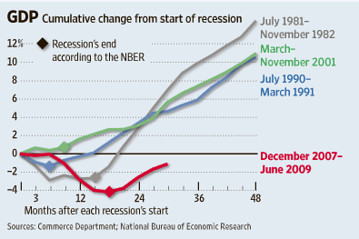
Pretty well, it turns out. [HT: WSJ]. We'll never know the precise causal link, but I am inclined to believe that the relatively quick and aggressive fiscal stimulus, along with the very aggressive actions on the part of the Fed, have a lot to do with it. This seems to be good fodder for the austerity vs. stimulus debate: at least according to these numbers stimulus is winning the short term battle, we'll wait and pass judgement on the longer-term struggle.
Here is the essential chart:
Showing posts with label recession. Show all posts
Wednesday, April 6, 2011
Thursday, January 20, 2011
How is Corporate America Thriving in the Recession?
A question I get asked a lot is how can it be that so many American companies are turning healthy profits, and the Dow soaring, during such a damaging recession. The answer I typically give is that US firms are very malleable and are able to quickly deal with lower demand. What I mean by this is the relatively laissez faire labor market in the US makes it easy to shed workers and the threat of doing so makes it easier to get workers to put up with increased work loads, longer hours, etc. So many firms are able to quickly adjust to the new demand they face and do just fine, thank you very much...
Now David Leonhardt has a more nuanced take of the seeming disconnect in the unemployment rate and the stock market in the New York Times. Here is an excerpt:
Alone among the world’s economic powers, the United States is suffering through a deep jobs slump that can’t be explained by the rest of the economy’s performance.
The gross domestic product here — the total value of all goods and services — has recovered from the recession better than in Britain, Germany, Japan or Russia. Yet a greatly shrunken group of American workers, working harder and more efficiently, is producing these goods and services.
The unemployment rate is higher in this country than in Britain or Russia and much higher than in Germany or Japan, according to a study of worldwide job markets that Gallup will release on Wednesday. The American jobless rate is also higher than China’s, Gallup found. The European countries with worse unemployment than the United States tend to be those still mired in crisis, like Greece, Ireland and Spain.
Economists are now engaged in a spirited debate, much of it conducted on popular blogs like Marginal Revolution, about the causes of the American jobs slump. Lawrence Katz, a Harvard labor economist, calls the full picture “genuinely puzzling.”
That the financial crisis originated here, and was so severe here, surely plays some role. The United States had a bigger housing bubble than most other countries, leaving a large group of idle construction workers who can’t easily switch industries. Many businesses, meanwhile, are reluctant to commit to hiring workers out of a fear that heavily indebted households won’t spend much in coming years.
But beyond these immediate causes, the basic structure of the American economy also seems to be an important factor. This jobless recovery, after all, is the third straight recovery since 1991 to begin with months and months of little job growth.
Why? One obvious possibility is the balance of power between employers and employees.
Relative to the situation in most other countries — or in this country for most of the last century — American employers operate with few restraints. Unions have withered, at least in the private sector, and courts have grown friendlier to business. Many companies can now come much closer to setting the terms of their relationship with employees, letting them go when they become a drag on profits and relying on remaining workers or temporary ones when business picks up.
Just consider the main measure of corporate health: profits. In Canada, Japan and most of Europe, corporate profits have still not recovered to precrisis levels. In the United States, profits have more than recovered, rising 12 percent since late 2007.
For corporate America, the Great Recession is over. For the American work force, it’s not.
I encourage you to read the rest at the NYTimes.
Anyway, the chicken and egg problem is strong right now, corporations are sitting on a lot of cash and not investing because they are waiting for a sign that demand is going to surge, but of course with so many unemployed demand is not likely to surge.
One last little excerpt from the piece:
Improving high schools and colleges — reclaiming the global lead in education — would help even more. Remember, the jobless rate for college graduates is only 4.8 percent, and some highly skilled jobs continue to go unfilled.
In an economy where skilled labor is our comparative advantage, it pays to be skilled.
Monday, September 27, 2010
The New Face of Poverty in Oregon
It won't surprise anyone that the demand for state services associated with poverty has increased dramatically in the current economic downturn. But the dramatic increase in households needing assistance is unprecedented, for example there was a 58 percent increase in participating households from 2005 to 2009.
This comes from a new study of SNAP, the state food stamp program, reveals how dramatically the population needing assistance has changed. Suzanne Porter a student in the OSU Master of Public Policy program, and Mark Edwards, a sociology professor at OSU, in a new report show that many of the new recipients of SNAP have no recent history of SNAP receipt, that many of the new SNAP recipients come from manufacturing and construction and are therefore disproportionately male, and that many households have a full-time worker.
Here is the report:
Newly Poor in the Great Recession
This comes from a new study of SNAP, the state food stamp program, reveals how dramatically the population needing assistance has changed. Suzanne Porter a student in the OSU Master of Public Policy program, and Mark Edwards, a sociology professor at OSU, in a new report show that many of the new recipients of SNAP have no recent history of SNAP receipt, that many of the new SNAP recipients come from manufacturing and construction and are therefore disproportionately male, and that many households have a full-time worker.
Here is the report:
Newly Poor in the Great Recession
Monday, September 20, 2010
The Recession Ended Over a Year Ago
This is no surprise: the NBER has just declared that the recession ended in June 2009. What is also not going to be a surprise are the inevitable and endless comments from the lay population about how if the recession is over how come I don't feel better? It is a good question and highlights the problem with economic terms and the ability of the profession to communicate effectively. Many people realize that a recession is just that, when the economy is in recess or not growing. In fact the key characteristic of a recession is prolonged negative growth. Yes they take more into account than that, but it is the basic metric.
This appears in contrast to how people tend to think of recession not being over until we have returned to where we where prior to the onset of the downturn. A medical analogy is apt: killing of harmful bacteria that have made you ill, versus recovering to your pre-illness strength. Economists using the term recession are speaking only of the first part.
Which, of course, suggests that economists might want to think about coming up with a pair of terms that describe the contraction and the recovery. In fact they could use those two terms and officially date the contraction (instead of recession) and come up with a definition of recovery based on unemployment numbers, GDP per capita, etc. The problem is in defining these. Often recessions follow periods of overheating in the economy, so waiting for unemployment levels that immediately preceded this downturn could take decades. But getting back to 6%, rather than 4% is probably enough to declare the recovery. The problem is economists like precision and it would be very difficult to come up with a set of benchmarks to define the recovery (perhaps within 25% of the levels of peak unemployment and GDP per capita in the year prior to the official start of the contraction).
At any rate the NBERs declaration of the end of the recession in June 2009 is unlikely to make anyone feel any better and will inevitable lead to the derision of economists. But we are used to it.
This appears in contrast to how people tend to think of recession not being over until we have returned to where we where prior to the onset of the downturn. A medical analogy is apt: killing of harmful bacteria that have made you ill, versus recovering to your pre-illness strength. Economists using the term recession are speaking only of the first part.
Which, of course, suggests that economists might want to think about coming up with a pair of terms that describe the contraction and the recovery. In fact they could use those two terms and officially date the contraction (instead of recession) and come up with a definition of recovery based on unemployment numbers, GDP per capita, etc. The problem is in defining these. Often recessions follow periods of overheating in the economy, so waiting for unemployment levels that immediately preceded this downturn could take decades. But getting back to 6%, rather than 4% is probably enough to declare the recovery. The problem is economists like precision and it would be very difficult to come up with a set of benchmarks to define the recovery (perhaps within 25% of the levels of peak unemployment and GDP per capita in the year prior to the official start of the contraction).
At any rate the NBERs declaration of the end of the recession in June 2009 is unlikely to make anyone feel any better and will inevitable lead to the derision of economists. But we are used to it.
Monday, December 21, 2009
Temp Hiring Surging - A Good Sign
For those looking for good news about the recovery, here is a big one: hiring of temporary workers is surging, which is generally seen as a key leading indicator. This is so because businesses will often bring on temporary workers as business picks up before they commit to permanent ones so that they can wait and see whether the new demand will persist. It appears that this time they are waiting much longer than in the past to make that commitment, however, suggesting there is still a lot of nervousness about the future direction of the economy.
The New York Times reports:
As demand rose after the last two recessions, in the early 1990s and in 2001, employers moved more quickly. They added temps for only two or three months before stepping up the hiring of permanent workers. Now temp hiring has risen for four months, the economy is growing, and still corporate managers have been reluctant to shift to hiring permanent workers, relying instead on temps and other casual labor easily shed if demand slows again.
“When a job comes open now, our members fill it with a temp, or they extend a part-timer’s hours, or they bring in a freelancer — and then they wait to see what will happen next,” said William J. Dennis Jr., director of research for the National Federation of Independent Business.
The rising employment of temp workers is not all bad. However uncertain their status, they do count in government statistics as wage-earning workers, adding to the employment rolls and helping to bring down the monthly job loss to just 11,000 in November. Indeed, the unemployment rate fell in 36 states in November, the Bureau of Labor Statistics reported last week, partly because of the growing use of temps.
The bureau, which issues the monthly employment reports, does not distinguish between permanent and casual employment, with one exception: it has a special category for temp workers, the men and women supplied by Manpower, Kelly Services, Adecco and other agencies.
Last month 52,000 temps were added, greater than the number of new workers in any other category. Not even health care and government, stalwarts through the long recession, did better.
Friday, November 6, 2009
Things are Getting Better...Slowly
Despite the dismal US unemployment report, there are signs that the economy is stabilizing and even turning the corner, albeit slowly. In Oregon, The UO Index of Economic Indicators rose again last month suggesting that the state is, along with the US, gradually coming out of the recession.
Credit markets have stabilized, but banks are still hoarding capital and focusing on investments rather then commercial banking so credit is still scarce. Today's Oregonian has a nice graphic showing how SBA backed small business loans have reduced significantly in the state (but, of course, it is not available on line).
Also, consumption spending, which had been recovering, took an unexpected fall in September as did real disposable personal income. Consumer confidence also dropped.
However, factory orders are up and inventories are down which is good news.
So how is the economy in the US overall. Well, there is a lot to be hopeful about, but still a number of cautionary signs which, to me, tell a story of recovery, but slow and 'jobless.'
Here is a look at some recent signs of US economic health:
Productivity growth soared in Q3, increasing at a rate of 9.5%. October retails sales in the US showed healthy growth as well. Initial jobless claims are decreasing and have been for a while, but are still high - suggesting that job losses will continue for some time yet. [And note that productivity soared with a cutback in labor utilization] Vehicle sales and home sales are up after having been spurred by incentive programs, so it is not clear that they will continue, but the programs have succeeded in staunching the bleeding in those sectors.
Credit markets have stabilized, but banks are still hoarding capital and focusing on investments rather then commercial banking so credit is still scarce. Today's Oregonian has a nice graphic showing how SBA backed small business loans have reduced significantly in the state (but, of course, it is not available on line).
Also, consumption spending, which had been recovering, took an unexpected fall in September as did real disposable personal income. Consumer confidence also dropped.
However, factory orders are up and inventories are down which is good news.
Some are now arguing that a new round of fiscal stimulus is needed to sustain, and make more robust, the recovery. I disagree. It may be true that more stimulus could be helpful, but I just don't think that we can accomplish it given they way it has been handled up to this point. Frankly, it is hard to spend that much money quickly and effectively. I thought the first round was so necessary that it was worth the tradeoff, I don't think that about the second. Perhaps if we were talking about block grants to the states...but even then I think the marginal positive impact of additional stimulus is now outweighed by the marginal negative impact of the additional debt necessary to fund it.
And, of course, unemployment is going to be the last thing to improve, so as today's unemployment report illustrates, things can be getting better but we can still see the worsening of the unemployment situation.
Friday, October 16, 2009
Crisis Watch: Good News Friday
I have been trying to find some areas of optimism and this is a big one, from MarketWatch:
Here is a nice picture from Calculated Risk showing the increase in capacity utilization in perspective:

This is also a nice illustration of a little economics riddle: how can there be so much underutilized capacity just sitting around? One answer is the liquidity trap which may well describe where we are - no one wants to lend at any interest rate so we are all just sitting on our hands. But it is this picture essentially that leads the few optimists among us to think that we may be in for a robust recovery. So much capacity tha could ramp up in a very short time period...
U.S. Sept. industrial production up 0.7%
WASHINGTON (MarketWatch) -- Led by a rebound in autos, metals, and high-tech, U.S. industrial production increased at an annual rate of 5.2% in the third quarter, the fastest growth in four years and the first quarterly increase since the recession began in late 2007, the Federal Reserve reported Friday. Output of the nation's factories, mines and utilities rose 0.7% in September after an upwardly revised 1.2% gain in August and a 0.9% increase in July, the Fed said. The 0.7% increase in output in September was stronger than the 0.4% gain expected by economists surveyed by MarketWatch. Manufacturing output rose 0.9% in September. Capacity utilization rose to 70.5% in September from a revised 69.9% in August.
Here is a nice picture from Calculated Risk showing the increase in capacity utilization in perspective:

This is also a nice illustration of a little economics riddle: how can there be so much underutilized capacity just sitting around? One answer is the liquidity trap which may well describe where we are - no one wants to lend at any interest rate so we are all just sitting on our hands. But it is this picture essentially that leads the few optimists among us to think that we may be in for a robust recovery. So much capacity tha could ramp up in a very short time period...
Thursday, October 8, 2009
Yet Another "Good News But..." Statistic
From the Calculated Risk blog, this nice picture showing why the news that weekly unemployment claims are falling is good, but that we have a long way to go before we are back to pre-crisis levels...like so many other economic statistics these days. Is the Recession in Oregon Ending?
Yes, according to the The University of Oregon Index of Economic Indicators which rose in August half a percent.
Monday, June 29, 2009
Will Oregon Start to Recover Soon?
Tim Duy thinks so (as do I) but we both agree that the recovery could be a very slow one, especially as seen through the employment metric. I am still sticking to my Q4 of 2009 prediction of the end of the recession, but it won't be pretty for a quite a while after that.
Friday, June 12, 2009
Poll Results: Uncertainty Reigns
The poll has been closed for a week now and I have been meaning to talk about it for a while and now I shall finally do so. There was a broad consensus that sometime in the range of Q4 2009 to Q2 2010 we will see the recession end - but also that the contraction will extend into 2011, suggesting that there is a lot of pessimism out there still. Though I wonder if some have in their minds when the economy will recover, not start to recover as the poll was asking.
In a related topic Moody's Economy.com labeled Oregon as one of the states it expects to see turn around first. I hope that they are right, but I am a bit skeptical: I am not sure that pent-up demand for technology is going to really filter down to Oregon that quickly unless there is strong demand from abroad as well, and that is a big question mark.
But I hope they are right. I answered Q4 2009 in the poll, by the way, and I still think we will see an end of the fall by then, but I also anticipate a slow recovery.
Thursday, May 21, 2009
Searching for Some Light at the End of the Tunnel
Let's forget about the other dismal stuff and take some solace in the fact that the Conference Board's index of leading economic indicators is up for the first time in many months (graph from the New York Times):
Thursday, May 7, 2009
Beeronomics: Is Craft Beer Recession Proof After All?
I stumbled across this little tidbit when I was looking for some coverage of Boston Brewing's Q1 report (the essence is business is down at Boston Brewing about 5%). Here is the interesting passage from the Patriot Ledger of Quincy MA:
What is particularly interesting to me is that I had assumed that imports were probably a decent proxy for craft beer sales and I knew sales of imports have been down. But in reality it seems that consumers are very loyal to craft beers and not shifting to macro from craft. In economics terms the cross-price elasticity of craft and macro brews appears to be very inelastic, or that beer drinker do not think of macro lagers as a good substitute for micro brews.
This is good news, I wonder if Oregon brewers are experiencing the same thing? I hear through the grape vine that things have been tough, perhaps this is due to inventory depletion on the part of distributors and retailers (something that would explain the seeming 3 percent down 3 percent up contradiction in the second and third paragraph). If this is the case, inventory depletions rather than sales, we might see a lot of new orders coming in soon as the inventories run out.
But Boston Brewing's recent struggle also suggests that within craft beer the environment is getting more and more competitive and they need to continue to fight off the challenge of all of the new 'it' beers that come along. As I mentioned a few days ago, I think this is precisely why Deschutes is pushing its specialty releases hard.
This is also good news for my brother, who is finishing his master brewer certificate program soon and is looking for work. He has offers in hand, but nothing yet from Oregon. Anyone hiring out there?
Craft beer sales appear to be holding up during the recession, boosted by customers strong demographics.
Throughout the U.S. beer industry, overall shipments from brewers have declined 3 percent year-to-date compared with the previous year, said Benj Steinman, president of the trade publication Beer Marketer’s Insights. Import shipments have declined 19.3 percent, with domestic shipments down 1.8 percent.
For the 52 weeks that ended on March 9, craft beer sales rose 12.6 percent from the previous 52-week period, compared with 3 percent for all beer, according to data from market researchers the Nielsen Company.
What is particularly interesting to me is that I had assumed that imports were probably a decent proxy for craft beer sales and I knew sales of imports have been down. But in reality it seems that consumers are very loyal to craft beers and not shifting to macro from craft. In economics terms the cross-price elasticity of craft and macro brews appears to be very inelastic, or that beer drinker do not think of macro lagers as a good substitute for micro brews.
This is good news, I wonder if Oregon brewers are experiencing the same thing? I hear through the grape vine that things have been tough, perhaps this is due to inventory depletion on the part of distributors and retailers (something that would explain the seeming 3 percent down 3 percent up contradiction in the second and third paragraph). If this is the case, inventory depletions rather than sales, we might see a lot of new orders coming in soon as the inventories run out.
But Boston Brewing's recent struggle also suggests that within craft beer the environment is getting more and more competitive and they need to continue to fight off the challenge of all of the new 'it' beers that come along. As I mentioned a few days ago, I think this is precisely why Deschutes is pushing its specialty releases hard.
This is also good news for my brother, who is finishing his master brewer certificate program soon and is looking for work. He has offers in hand, but nothing yet from Oregon. Anyone hiring out there?
Friday, April 10, 2009
Kids are not Recession Proof
"Uptick in Vasectomies Seen as Sign of Recession" reads the New York Times' headline. My first thought was, ummm...come again? Sure kids are expensive, but so are vasectomies and if incomes are tight why should there be an increase? Should they not see a decrease and less expensive alternatives like condoms see a big increase? I didn't think most insurance covered an elective surgery like this. Besides, as retirement accounts crash, and with future social security payouts likely to go down, children are a good form of old-age insurance, right?Well, no it turns out. Most insurance does pay, or so claims the reporter, and in our society the present discounted value of the cost of kids is surely much higher than the expected present discounted value of the insurance aspect. So perhaps this is evidence of recession effects - kids as luxury goods, you might say.
However the cost (in terms of money, time and discomfort) seems really low and it strikes me that perhaps this has seen a big change in recent years which would, of course, lead to an increase in quantity demanded. Is this true? Anyone?
I am not ready to accept the hypothesis of the article, but it is an interesting theory...
Friday, April 3, 2009
Beeronomics: Craft Brews and the Recession
Jeff Alworth has a wonderful post on the 25th Anniversary of Widmer Brothers Brewing Co. Well worth a read and congrats to the Brothers Widmer!Unfortunately, this economic downturn is starting to take its toll on the craft brewing industry in Oregon. The Portland Business Journal is reporting the $33 million loss that the Craft Brewing Alliance, the company created by the Widmer - Redhook merger, suffered in 2008. Trends in the local brewing industry are worrisome as consumers abandon the more expensive craft brews for cheaper substitutes. From the article:
December and January shipments for all Oregon craft brewers fell by 5 percent and 7 percent, respectively. But in January and February, shipments for all beer in Oregon actually rose by 10 and 20 percent, spectively. “It would appear trading down from higher-priced, locally-made beer has already begun in earnest,” said Brian Butenschoen, executive director of the Oregon Brewers Guild.
This substituting cheaper alternatives has always been my concern for the local brewing industry. Just as department stores like Macy's are suffering while Walmart is thriving, during a downturn the purveyors of cheap substitutes tend to do well relative to their more expensive counterparts. This works both ways, however, which is part of the reason why craft brewing did so well during the last boom period. As this recession is going to be long and deep, I wonder how the breweries will fare. This is also a time in which big brewing conglomerates might try and snap up ailing independent brewers so that they have products with which to compete when the recession turns around.
Tuesday, January 27, 2009
Beeronomics: Pubs and Recessions
Over on the Beervana blog, Jeff has posted a poll about beer drinking habit changes in a recession. In a visit to a half full Portland pub on a recent Friday night, he wondered whether pub going is declining in the recession in favor of drinking at home. In the comments a reader mentions that pub going for her has not decreased as pubs are a substitute for higher priced bars and restaurants.
As I wrote in the comments, it is an interesting question: are brewpubs less expensive alternatives to higher priced bars and restaurants - or are they more expensive alternatives to drinking beer at home? I suspect both, but which is dominant in a recession?
My infrequent pub going experience has been to pretty packed pubs in Portland these days, so I would imagine that the former effect is at least as large as the latter in Portland.
But news from the "Land of Pubs" suggests that this is not generally true. Apparently in-pub beer sales are down almost 10% in the UK. Supermarkets and off-licenses (shops that are allowed to sell carry-out alcohol) beer sales are down 6.5%. So it seems that Brits are substituting carry out beer for pub drinking, but overall the pub industry in the UK is in big trouble.
What about for you, still frequenting the pubs?
Thursday, November 6, 2008
Now What?

Now that the Obama and Merkley have won, the reality of the enormous challenge of the current economic catastrophe is sobering. With respect to John McCain, the fundamentals of the economy are not strong and Oregon, along withthe rest of the country, is facing the real prospect of a deep and long resession that will bring with it large scale unemployment and crashing state revenues. [And by the way, to reference an earlier debate on tax structure, consumer spending declines and job losses are happening concurrently, so it is not clear that sales taxes would help that much] We are well along in the process of economic meltdown, and pretty far along in attacking the issue at the forefront of the problem: the credit crisis. Progress has been slow, but it is happening: the LIBOR is down, the TED Spread is down, the A2P2 spread is down (a measure of the health of the commercial paper market), but Treasuries are still too low (indicating a lingering flight to safety urge). However, there are still a lot of serious problems with the financial health of major banks and corporations, and consumer confidence has completely fallen off a cliff.
So what is the federal government to do? A number of prominent economists are now urging ramping up fiscal spending on domestic projects (think WPA and CCC). Some suggest that this should be done through transefers to states for infrastructure projects to help stabilize state budgets. The basic idea behind such spending (besides the direct benefit of helping out unemployed families and the like) is that by getting money into the hands of consumers you provide a boost to spending, allowing revenues to flow to firms who can invest and create new jobs, etc. Essentially it is to stop the downward spiral we are currently in of a contraction in spending, thus a contraction in jobs, thus a further contraction in spending in spending...

I think that the idea is essentially correct, though I am cautious about the scale of such an enterprise. But I think it can also be done with the goal of improving the future economy in mind. Investments in renewable energy projects, mass transit, education - especially through support for university tuition - could yield not only a quicker and more robust recovery, but could also create an asset that yields dividends long into the future.
I think it is also necessary to resist the appeals to populism that could negatively impact future growth in Oregon and in the US. Jeff Merkley's increasingly populist protectionist rhetoric makes me worried that democrats will use their newfound power to reverse some of the progress we have made. We need more intelligent trade policy for sure, but we do not need less trade.
This will be a trying couple of years for the democrats as they try to steer the US out of the economic doldrums, they can do so two ways - they can use this period of adjustment to make fundamental changes in the economy that will ensure a brighter future, or they can return to the failed policies of the past that will leave us more isolated and further behind. Let's hope they get it right.
Subscribe to:
Posts (Atom)