Friday, June 17, 2011

Friday Links

As promised I have been lame this week and there is probably much more lameness in the near future.

In that vein, I shall now punt and direct you to some interesting reads.

Josh Lehner at the Oregon Office of Economic Analysis has a couple of very nice posts about the employment situation in Oregon.

Here is a teaser:


In the old "correlation is not causation" vein, Justin Wolfers takes on the Economist in the Freakonomics Blog.  Here is another teaser:


Finally, how does Oregon's unemployment rate compare?  See the Wall Street Journal for some interesting discussion.  And, of course, the tease:

Tuesday, June 14, 2011

Oregon Unemployment Falls to 9.3% in May

The Oregon economy returned to positive job growth in May, adding 1,300 jobs and the state's unemployment rate fell to 9.3%, almost matching the US average.   Manufacturing was a disappointment, it added only 100 jobs when 1,100 new jobs is usual, thus it lost 1,000 jobs on a seasonally adjusted basis.  By contrast, financial activities added 1,500 jobs on a seasonally adjusted basis.  Trade, transport and utilities and educational and health services both saw strong gains as well.

Picture of the Day: Taxes

Here is one perspective on US taxes from the left-leaning Center for American Progress which argues that the US is a low-tax country.  I think graph 2 makes the best case in general, and it is not really surprising - we certainly have different notions of the appropriate role of government then, say, Denmark.


Meaningful?  Discuss.

Monday, June 13, 2011

The Jerks Have Landed! Sellwood Cycle Repair's New Digs

[NOTE: The spring term just ended and I am exhausted and a bit burned out on economics to be honest (as, I am sure, are my students), so there will probably be mostly intermittent and econ-less blogging this week, my apologies]


On the list of great improvements in the neighborhood, this is at the very top: into the old Furbish Chemical and Supply Co. building has moved the amazing Sellwood Cycle Repair.  These guys are the best (search around for the source of the 'What a Bunch of Jerks' moniker - they are anything but).


They bought the dreary chemical building, completely renovated it and they now have a space that is ten times bigger than their old shop on SE Milwaukie.  The new shop is magnificent and, contrary to what the name suggests, they are a full service retail shop as well with bikes, equipment and supplies.  They are now open and I can't be happier as my bike is badly in need of a complete tune-up.

My love affair with this place started when I just arrived in the neighborhood and our Burley trailer was having a problem with a wheel that was rubbing against the frame.  We took it in and they couldn't see an immediate remedy.  So the manager (I believe that is what he is), Jeremiah, called the manufacturer who (to their great credit as well) admitted to a manufacturing or design defect that affected this model and swapped it for a brand new model - all through the shop which had neither sold it to us nor was a Burley dealer.  After a number of phone calls on our behalf, shipping the old one off, receiving the new one, and finally building the new one for us they didn't ask us for a penny in return.  We finally got them to accept some money for building the new trailer for us after we insisted.

We now go to them for all our bike servicing needs and not just because they are convenient - because they are great! Now with the new store I can go to them for all the other stuff too: bikes, helmets, locks, etc.  Super-cool.

Besides they are now even closer to my house than before.  Welcome the jerks!

NB: I blogged about two other new beery neighbors in my beer blog if you are interested in Sellwood comings and goings.

Thursday, June 9, 2011

India: Growth Despite Government


Absolutely essential reading from The New York Times: an article on India's extraordinary economic growth that has come despite a government that struggles to provide even the most basic infrastructure:

In Gurgaon [a suburb of New Delhi] and elsewhere in India, the answer is that growth usually occurs despite the government rather than because of it. India and China are often considered to be the world’s rising economic powers, yet if China’s growth has been led by the state, India’s growth is often impeded by the state. China’s authoritarian leaders have built world-class infrastructure; India’s infrastructure and bureaucracy are both considered woefully outdated.

Yet over the past decade, India has emerged as one of the world’s most important new engines of growth, despite itself. Even now, with its economy feeling the pressure from global inflation and higher interest rates, some economists predict that India will become the world’s third largest economy within 15 years and could much sooner supplant China as the fastest-growing major economy.

Moreover, India’s unorthodox path illustrates, on a grand scale, the struggles of many smaller developing countries to deliver growth despite weak, ineffective governments. Many have tried to emulate China’s top-down economic model, but most are stuck with the Indian reality. In India, Gurgaon epitomizes that reality, managing to be both a complete mess and an economic powerhouse, a microcosm of Indian dynamism and dysfunction.

In Gurgaon, economic growth is often the product of a private sector improvising to overcome the inadequacies of the government.

To compensate for electricity blackouts, Gurgaon’s companies and real estate developers operate massive diesel generators capable of powering small towns. No water? Drill private borewells. No public transportation? Companies employ hundreds of private buses and taxis. Worried about crime? Gurgaon has almost four times as many private security guards as police officers.

“You could call it the United States of Gurgaon,” said Sanjay Kaul, an activist critical of the city’s lack of planning who argues that Gurgaon is a patchwork of private islands more than an interconnected city. “You are on your own.”

I am busy today so I'll only add this thought: Much of this reveals a pattern of allowing the wealthy minority to build for themselves a society within a society. But this will soon test India's democratic identity, for this cannot go on indefinitely without the 90% of India that is left out. The state must begin to step in and start to provide essential services for those who cannot afford to buy them privately. And the private provision of these services is usually hugely inefficient and will eventually become a major drag on growth.  India needs to begin aggressively inserting the state back into the fray in other words.

It also reminds me a bit of Brazil, but for all the corruption and inefficiency in Brazil, the state is much better functioning in general.  They lost control of the favelas, but have began a program of re-integrating favelas into the bureaucracy: providing services, enforcing building codes, etc.  This might be a model for India.

Tuesday, June 7, 2011

Soccernomics: Size Matters Redux

Emirates Stadium - Home of the Arsenal

I see the Timbers are getting a little touchy about the size of their field:

Portland are 5-1 in league play at their home. And yet, over the past month, a couple of opposing coaches have publicly taken issue with JELD-WEN Field’s size and suggested that it plays into the Timbers’ favor.

“The pitch, because it’s a little bit too small, when you watch the games they played at home, it’s a little pinball,” Philadelphia Union coach Peter Nowak told local reporters prior to the May 6 game in Portland. “[The Timbers] press the other team, and we’ve got to figure out a good plan for that.”

Too small?

At 70 yards wide, 110 yards long, the pitch at JELD-WEN Field is FIFA certified and meets the governing body’s guidelines as well as those of MLS. Field dimensions are not fixed from one pitch to the next and are a bit like Major League Baseball ballparks in that sense.

The oldest club in English Premier League soccer, Stoke City, play in a stadium with exactly the same dimensions as JELD-WEN. Do other EPL teams complain that it is too small?

Less than two weeks after Nowak brought it up, Columbus Crew coach Robert Warzycha chimed in with his thoughts on Portland’s success at home.

“More than anything, it’s the [artificial] turf and the field dimensions,” Warzycha told the Columbus Dispatch. “And the way they play at home. They’re scoring on set pieces.”

For the record, Portland did score on set pieces to beat both Philadelphia and Columbus. But was the size of the field really working against the opponent?

At JELD-WEN Field, the dimensions are dictated to some degree by the configuration of a stadium footprint that dates to 1926. It also has to do with sight lines for spectators. (From the press box, it is difficult to see the near touchline with out standing up.)

They doth protest too much.  Of course the quote from Ben Olsen that was in my last post was from the coach of a winning team so there is no suggestion of making excuses with him.

Anyway, what strikes me in all of this is the explanation that sight lines are to blame, but not from the stands mind, from the press box!  Are you serious?  You would shrink your field just so those in the press box don't have to stand up?!?  That is so lame.

And by the way, bringing up Stoke City is neither here nor there, but since they did, there is a big difference between the level of play in the Premier League and the MLS for one, and for two Stoke City is grass so the size is not amplified by a fast bouncy plastic surface.  I don't believe that any other Premier League team has a pitch smaller than the 75x110 yards (the modern stadium standard).  Arsenal did have a Jeld-Wen size field and used to be known for cynical defensive football, but then Arsene Wenger came in and instilled a possession, quick passing style of play utilizing world class players who could pull it off.  Still, when they built their new stadium they went to 75x115.

Just sayin'

Monday, June 6, 2011

Eco-nomics: Malthus and Global Warming - Will There be Enough Food?

Josh Haner/The New York Times

Over the weekend, The New York Times had an interesting and provocative article on the fate of the world food supply in the face of global warming.  And, once again, we are faced with the prospect of a planet that keeps adding more people and a food supply that might not be able to keep up.  Similar to debates in the 1960s and 1970s that went away with the Green Revolution, new debates are beginning to arise about how, and if, humanity will adjust:

Perhaps the most hopeful sign nowadays is that poor countries themselves are starting to invest in agriculture in a serious way, as many did not do in the years when food was cheap.

In Africa, largely bypassed by the Green Revolution but with enormous potential, a dozen countries are on the verge of fulfilling a promise to devote 10 percent of their budgets to farm development, up from 5 percent or less.

“In my country, every penny counts,” Agnes Kalibata, the agriculture minister of Rwanda, said in an interview. With difficulty, Rwanda has met the 10 percent pledge, and she cited a terracing project in the country’s highlands that has raised potato yields by 600 percent for some farmers.

Yet the leading agricultural experts say that poor countries cannot solve the problems by themselves. The United Nations recently projected that global population would hit 10 billion by the end of the century, 3 billion more than today. Coupled with the demand for diets richer in protein, the projections mean that food production may need to double by later in the century.

Unlike in the past, that demand must somehow be met on a planet where little new land is available for farming, where water supplies are tightening, where the temperature is rising, where the weather has become erratic and where the food system is already showing serious signs of instability.

“We’ve doubled the world’s food production several times before in history, and now we have to do it one more time,” said Jonathan A. Foley, a researcher at the University of Minnesota. “The last doubling is the hardest. It is possible, but it’s not going to be easy.”

The debate has been labeled as one between the Malthusians (i.e. those pessimistic about food supplies keeping ups with population) and economists (who generally believe that with dwindling supplies come higher prices and strong incentives to innovate). The author of that article has a follow-up in the Times' Green blog that discusses precisely this debate.  The tenor of his article and his blog post is essentially 'this time we might not be able to innovate out of the problem:'

In general, these pessimists about the human future have turned out to be wrong — so far. The missing ingredient in doomsday prognostications, about the food supply or anything else, is an appreciation of the power of innovation to solve problems.

***

Economists consider Malthusianism, at least as understood in modern times, to be a discredited doctrine. From their perspective, one powerful lever explains why innovation always seems to come to the rescue when it is needed most: prices.

Most people intuitively understand that the reason prices rise in times of scarcity is to allocate the available supply. It may be less obvious that higher prices serve another, more crucial function: they call forth additional supply. Higher prices reverberate through an economy like a clarion call, saying to capitalists everywhere: Produce more!

***

“Where Malthus and his modern-day followers go wrong is that they miss the power of prices to drive the technological change that has helped societies adapt to all kinds of events and will help us to adapt to climate change,” Michael Greenstone, an economist at the Massachusetts Institute of Technology, told me by e-mail. “It is certainly possible that agricultural prices may end up being higher, but the apocalyptic visions of shortages are not supported by the long history of markets directing people to innovate in the areas where it is needed most.”

Without question, the potential for agriculture to adapt to climate change, to higher demand and to the other problems that confront it is substantial. Farmers can grow different varieties; they can plant them earlier to avoid hot spells; they can invest capital in water-saving systems like drip irrigation.

Within limits, agriculture can move north as the climate warms; some projections show wheat being grown in the future as far north as the shores of Hudson Bay, and even in parts of Alaska.

Gary Toenniessen, head of agricultural programs at the Rockefeller Foundation, pointed out to me that if prices got high enough, much of the United States could grow two crops a year instead of one. That is already done in parts of the country where winter wheat is grown, and it is being done even more intensively in Asia.

Both are very interesting reads and worthy of your investment in time, but the point I was to make here is that the price of food has many effects. Yes, it does provide a strong inventive to innovate, to use land and water more carefully, etc., but is also have an effect on households: larger families become more and more expensive.  Which, of course, was really Malthus' point in the first place - that humans respond to these market signals.

So, I am aligned with the economist camp described above, but I believe that if we do struggle with food production, the resulting higher prices will have a myriad of effects: agricultural innovation, shrinking households, more kitchen gardens, etc.  It is wrong, in other words, to focus only on whether science will keep up with humanity's appetite, but rather we should think through all the implications of rising commodities prices.

Friday, June 3, 2011

Horrible: The May Jobs Report

The US economy added only 54,000 jobs in May and unemployment is up to 9.1%.  54K is not enough to even keep up with population growth.  In other words we are losing ground not gaining.

More and more do I worry about the lost decade that Krugman has warned of repeatedly.  I have thought him a bit alarmist, but his insistence that the government is not taking this seriously enough and doing too little looks pretty prescient right now.

Let's hope this is true:

The dismal numbers may change the economic debate in Washington and potentially revive calls for the Federal Reserve to engage in another round of asset purchases, Mr. Ashworth said. Democrats and labor-oriented groups have also amplified their pleas for Congress to delay deficit-reduction measures.

“Living here in Washington, in the past few weeks there has been all this talk about deficits and the debt ceiling as though that were the biggest problem right now,” said Heather Boushey, a senior economist at the Center for American Progress, a liberal research organization. “My fervent hope is that this shocks policy makers into realizing the most urgent problem in front of us right now is jobs.”

Some smart analysis from the Economist:

It's not too difficult to spot the sources of economic weakness in the details of the report. Manufacturing employment fell by 5,000 jobs in May after rising steadily in previous months, a testament to the worsening outlook for exports in a weakening global economy. Retail trade employment growth also tumbled, as nervous consumers trimmed spending. America's job woes have also been self-inflicted. Private firms have added over 1.7m jobs in the past 12 months, but the government has shed nearly half a million over the same period (not counting the loss of temporary Census jobs last year). Local governments alone have cut 446,000 positions since September of 2008. Some of those government jobs losses reflect a sensible rationalisation of workforces. Too many of them reflect the damaging effect of pro-cyclical budget cutting due to balanced-budget rules in cash-strapped states. More federal aid to states might have dampened the reductions, easing the drag on national growth.

Budget issues at the federal level may also be contributing to the slowdown. Unexpectedly large federal budget cuts are chipping away at quarterly growth rates with less of a cushion than previously imagined. The 0.5 percentage point drag due to slashed spending seems less problematic when the economy is expected to expand at 4%—as was once hoped for the first half of 2011—than when it's growing at less than 2%, as America's did in the first quarter, and as forecasters are increasingly predicting for the second quarter.

I have, for my part, warned of the problem of 50 states making drastic budget cuts simultaneously and argued for some very quick and VERY easy fiscal stimulus: block grants to the states. Now, I think, we are beginning to see the problem manifest itself. Bad days.

Thursday, June 2, 2011

Economist's Notebook: A Lesson in Cost Disease


From Jack Bog's Blog I find this wonderful picture from a Radio Shack ad that was in a Popular Mechanics magazine from 1987.

Note the super duper lightweight portable cellular phone for only $1499!  That is almost $2900 in today's dollars.  Not only are cell phones remarkably cheaper, but they are an order of magnitude more capable.  You can buy an iPhone for $300 that is a super-computer by 1987 standards.

Which is a nice jumping off point for the discussion of 'cost disease.'  Which is actually a fairly simple concept.  When we measure inflation through time, we use the average price increases over a whole basket of goods which means we do it over a whole range of industries.  Some of these goods/industries (like cell phones/consumer electronics) are prone to huge productivity increases - meaning we can make the same good much less expensively now than before.  Other things are not a prone to such increases.  Books, for example, or (you know this was coming) craft beer.  

For example, I grabbed a book I bought around the same time off my shelf: In Exile from the Land of Snows. It has a cover price of $9.95.  The very same book today has a cover price of $16.00. [This was bought and ready during my time studying and traveling in India and Nepal, it is an account of the Dalai Lama and the Tibetan government in exile and is is highly recommended]  The price increase for the book is slightly lower than inflation but partly this represents the fixed costs (the price of the manuscript) being spread ever more thinly.  But in general, though we can now do electronic type setting and other productivity enhancing things, the printing of the word onto paper and binding it to ship and sell has not seen a lot of productivity enhancement over the last 25 years.

Anyway the point is that some products are less prone to productivity increases. The classic Baumol example is the symphony orchestra which takes just as many musicians just as much time to play a Mozart or Beethoven piece today as in the late 1700s.  There has been no productivity gain at all.

When you put them altogether and average the price increases across all different industries, you will see industries (like symphonies) that routinely see price increases greater than inflation and other industries (like consumer electronics) where prices actually keep falling.  We describe industries of the former type those that experience 'cost disease' because it is a natural consequence of an industry where productivity does not increase much.

Wednesday, June 1, 2011

Picture of the Day: The Bear that Saved the Day

Photo credit: Oregonian

Here is the Tualatin bear romping through the school field.  My son would like to invite it to his school since the Bear gave the Tualatin kids a day off school.  Way to go bear!

Picture of the Day: Income Expectations

From Mark Thoma via the Cleveland Fed comes this startling and depressing bit of survey data:


This is not what you want to see if you are hoping consumers will start the great recovery.

Tuesday, May 31, 2011

Soccernomics: Size Matters


An interesting blog post from Steve Goff, the Washington Post soccer reporter, on the DC United win in Portland (which was a dismal affair with almost no quality soccer to speak of). For a while I have been raising the issue of the tiny field at Jeld-Wen, and mostly being chided for worrying about it. But my point - that a small turf field is not conducive to beautiful soccer - is being echoed now by those who are covering and playing the matches.

First, here is Goff himself wondering why (as I have) the field cannot be expanded by a couple of yards in all directions:
On Jeld-Wen Stadium’s narrow pitch, two assists came off throw-ins (by Chris Pontius and Jeremy Hall) and the Dejan Jakovic penalty came off a throw. On United’s final goal, Bill Hamid could’ve been credited with a secondary assist. The dimensions are listed at 110 yards long, 70 yards wide. Oddly, there seems to be ample room to expand the playing surface to a more suitable size. The Timbers have conformed well to these tight quarters, but the matches lack elegance.
"Lack elegance" is one (nice) way to put it... A couple of yards sounds like nothing right?  But the difference between 70 by 110 and 74 by 114 is 10% more playing area.  The international standard right now for new stadia is 75 by 115, I think Portland should work with the league to allow for slightly less room behind the goals and out of touch or else this type of ugly ping pong and punting soccer is going to be the norm. Here is Goff quoting DC United coach Ben Olsen who mentions the field:
“It was about dealing with set pieces, and that’s what this field is about. Unfortunately, that’s what it is. It’s not fun to come here and play because it’s tough to play soccer. It’s about getting the balls into the box, but that’s the reality when you come here. Historically, we have lost when the field is small, when it’s turf, when it’s a real gritty game. The guys today were fed up with that and showed that they can compete physically with any team in the league.”
The emphasis is mine. Note that he doesn't say it is tough to come and play against the Timbers or in front of the Army, but that it is tough to actually play the game: control, passing, movement.  Instead what we get is a lot of punting the ball.

Ajax last wednesday showed that with players of enough quality you can play good soccer even on a small plastic field, but MLS is not up to this level yet and won't be for a long time.  I think this is a real potential problem for the business that is Portland Timbers.  Folks are not going to continue to spend money and time going out to the stadium and watching the match on TV if the game is going to be so sloppy and dull.

A Lesson in Causality


From The Oregonian:

John Tapogna, president of economics consulting firm EcoNorthwest and a seasoned researcher of school spending statistics, said the prospects for Oregon schools to return to above-national-average spending -- or to feel they've shed the constant need to cut back offerings, jobs or both -- are dim.

The main reason Oregon spends less is that Oregonians earn less than the national average -- so they have less to spend. As a whole, Oregonians consistently contribute 4 percent of their collective income to public schools, he said.

Oregon's economy and per-capita income would have to grow faster than the nation's to make it natural for Oregonians to increase their spending on schools faster than the nation, he said. And that's unlikely, according to the state economist and others.

Now how could Oregon make resident incomes grow faster?  I wonder...

Case-Shiller: Portland home Values Still Falling

The post title says it all: the March Case-Shiller report is out and US home values are still dropping significantly.

Here is Brent Hunsberger's write-up in the Oregonian and here is a nice sortable table from the Wall Street Journal.  You can see from the latter that Portland has seen the fourth worst year over year drop in home values, but is one of the better markets in terms of monthly change, losing only 0.7% of value over the last month.

I had assumed this year (2011) would be one of bumps but no significant gain or loss.  It'll take a minor recovery in the summer/fall for my prediction to come true and it is not looking so good right now.

Friday, May 27, 2011

What is the Education Stability Fund For?

This is, by almost any measure, the worst economic recession since the great depression. The recession has hit Oregon public schools particularly hard, given their dependence on the state's general fund and the general fund's dependence on income taxes. Because of the volatile nature of education funding in the state, the Education Stability Fund (ESF) was created to help cushion the blow to schools from economic downturns.

Given all that, why are legislators so reticent to spend all of the ESF? Why create a fund you are reluctant to use at the very moment it was designed for?  Here is The Oregonian's Kimberly Melton on recent developments in the state legislature:

In recent weeks, there is growing legislative support for giving K-12 schools some additional money, likely $50 million to $100 million from the education reserves. In everyday terms, that money could pay for up to 1,100 teachers or a full week of school for all students in the state.

In March, the co-chairs of the Joint Committee on Ways and Means recommended a $5.7 billion budget for K-12 schools, but said they would consider an additional $56 million for 2012-13 if the economy improves. But advocates haven't given up, saying that money is needed immediately to help blunt devastating reductions.

Their goal is still the additional $100 million they asked for initially, but as end-of-session negotiations intensify, many say $56 million is turning into viable middle ground that could help meet a variety of needs. The $56 million figure would give schools the same amount that they received for 2009-11.

I honestly don't understand the thinking behind not spending all you can. Research shows that temporary disruptions, such as large classes, even for just a year or two have long lasting impacts on student performance. The economy is recovering (albeit painfully slowly) so it is unlikely we'll need the ESF in the near future - but students are suffering now.

The state's Education Stability Fund is intended to help buffer schools during an economic recession. Three-fifths of each legislative chamber must approve any action to remove any of that money -- expected to grow to $300 million over the next two years. State legislators can tap the fund only in times of economic crisis or if the governor declares an emergency. As the state revenue forecasts begin to improve, some advocates fear that lawmakers will not be able to make those funds available during next year's session, as they originally intended.

"I think everyone can agree that there's at least $56 million available for K-12," said Democratic Majority leader Dave Hunt. "It's in the Education Stability Fund. Do we leave it under a mattress or invest it in our kids? I think that's an easy choice."

Indeed, but why only $56 million?

Thursday, May 26, 2011

Messi


For those uninitiated into the dazzling world of Lionel Messi (well, at least when he is in a Barça shirt), you have a prime opportunity to witness his genius on Saturday for the UEFA Champions League final where Messi's Barcelona take on Manchester United at Wembley Stadium in London.  The game will be on all the Fox channels including the over-the-air one.

To prepare yourself, read this excellent article on him from last sunday's New York Times.  Here is a tinly little snippet:

Messi grew homesick when he arrived with his father from Argentina, club officials said. He missed his mother and sometimes cried himself asleep. Quickly enough, though, he immersed himself in the Barcelona style, which demands flair and creativity, not mere utility. He played the keep-away game called El Rondo, in which one player stands inside a circle trying to steal passes made in tight spaces. He mastered the system known as tiki-taka, built around short, rhythmic passes and movement described by Iniesta as “receive, pass, offer,” triangular exchanges that form a spellbinding geometry.

Tiki-taka is generally understood to be the Spanish evolution of the Dutch 'Total Football' style that Johan Cruyff brought to Barcelona as manger in the late 80s and early 90s.  That style, incidentally was on display last night in Jeld-Wen Field were Ajax outclassed the Timbers and their performance exposed the gulf between upper tier European clubs and the MLS.  But I digress.  Barcelona is mesmerizing in their team movement of the ball and their players.  They apply immense pressure which only effective if the entire team is doing it together and in harmony.  No one is as good as Barça at this.

Messi is both comfortable in this system as well as in moments of such individual brilliance that it leave you breathless.   His quick combinations around the goal box that break through the most stubborn defenses as well as his mazy runs with the ball seemingly magnetically attracted to his feet make Messi the most exhilarating player in the world to watch.

I recommend it.

Wednesday, May 25, 2011

Soccernomics: Home Field Advantage


Rachel Bachman in The Oregonian has a nice article on home-field advantage in sports and how it is a bigger factor in MLS than in other major league sports.   Andrew Patterson, a Las Vegas oddsmaker, claims that the data show that:

In the NHL, home ice alone is worth about a 3-4 percent advantage. In Major League Baseball, home field is worth 5-6 percent. In the NBA, homecourt is worth 7-8 percent. In the NFL, home field is 8-10 percent.

In MLS, home field generally gives teams a half-goal advantage, Patterson said.

"A half-goal is worth more than 10 percent," he said. "It's huge. It's really big."

Economists have studied home field advantage, perhaps most prominently in soccer, where research from Europe suggests that referees are influenced by home crowds.  And there is also a literature that looks at sports betting behavior and whether such betting markets are efficient by adjusting prices to reflect such biases.

But as far as the particular advantage in soccer, I think it is less about the referees (there is no reason to believe that soccer referees are more or less influenced than in other sports I would suggest) but about the nature of the game of soccer with is a continuous flow with few substitutes.  There is no stopping and starting and momentum plays a big role so the crowd can help get the team going earlier in games.  Players also need to stay energized both mentally and physically for 90 minutes of almost constant running and the crowd can play a big role in keeping the players 'up' especially in the latter parts of the second half.

Tuesday, May 24, 2011

The Market Value of College Majors

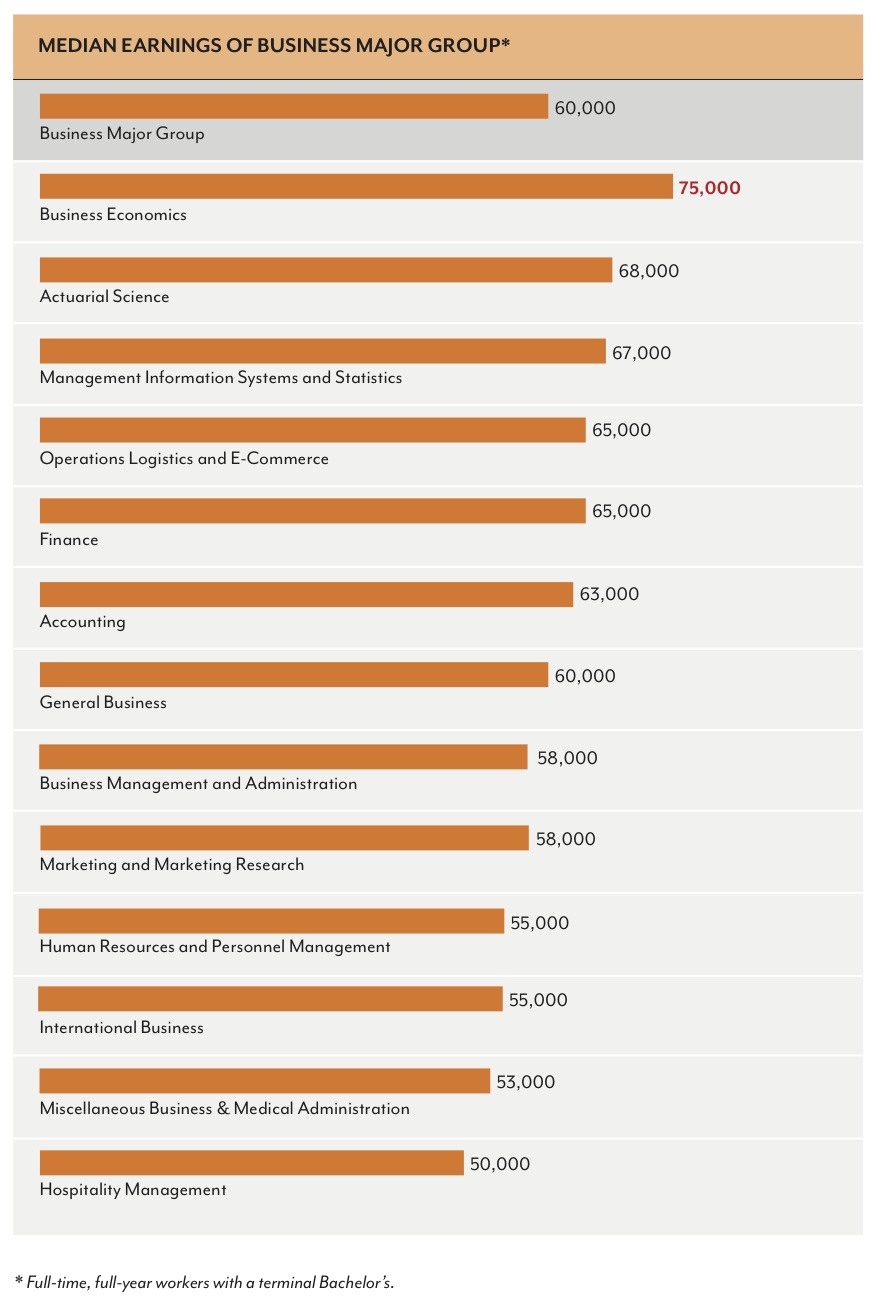
From the new report out of Georgetown University entitled "What's it Worth" comes a mountain of data about the market value of college majors.  Not surprisingly economics does very, very well.  It is not surprising because lots of previous data has shown economics to be a very valuable major and because of the skills that are developed in the course of an economics training - quantitative, analytic and expository - that are both rare and valuable across many professions.

Here is a look at the general data.  As usual, engineering comes out on top.  A fine and valuable skill and profession is engineering, but we often see engineering students who are quantitatively skilled but looking for some more social applications migrate to economics (and no doubt the reverse is true as well).


Social science is lower in general in the more general rankings, but when you break them up, you see the ascendance of economics as shown in the chart below. This doesn't show income for graduate degrees as in the one above, but the report says that there is a 50% salary bump in the data suggesting a $105,000 median income which is even better than engineering.


You might think that business would be even better (it is so applicable!), but you would be wrong. In fact the only business degree that is better is business economics. The rest are all worse than straight economics - probably because they don't emphasize the rigorous quantitative and analytical training that economics does that the market has determined is so valuable. The good news is that the OSU Economics Department offers both straight economics and business economics, which we call "Managerial Economics" because the business college wouldn't let us call it by its more common name. And you can get both of these degree options on line!


Having said all of this, I DO NOT suggest choosing a major based on market value, because a lot of what you are seeing is also a compensating wage differential. There are many people who are passionate about working in other areas that don't pay as well and are better off for following their passion than their checkbook.  Such folks are happy to make the trade off of a lower wage for a more personally fulfilling career.

Still if economics is your passion, it turns out to be a pretty good major choice both in terms of the likelihood of finding a job and of being paid well.

Monday, May 23, 2011

What is Wrong with a Weak Dollar?


Nothing, if you ask me - in fact it is the natural equilibration mechanism of the world economy and right now the very weak dollar is helping make US exports competitive abroad.  Brazil, right now, faces the opposite problem, the Real is so strong (thanks in large measure to the boom in commodities prices) that it is getting harder for Brazilian exporters to compete.  My experience in flying to São Paulo last fall was a flight from Chicago stuffed with Brazilians and their many purchases from US stores, while the flight home was somber - many Americans broke from a short stay in the metropolis.

Brazil faces troubling inflation and sagging exports.  The response to the former - tighter monetary policy - will increase interest rates and further the appreciation of the Real.  Both will slow down economic growth.  In the US, a weaker dollar and very low inflation will help speed the tepid recovery and keep a lit on imports as consumers will be daunted by their high prices.

But none of this is well understood among the average US worker, and perhaps the governments reluctance to talk openly about it is the culprit.

In the New York Times this weekend, Christy Romer argues that the government should speak more frankly about exchange rates and how they affect the economy:

Some countries, like China, essentially fix the price of their currency. But since the early 1970s, the United States has let the dollar’s value move in response to changes in the supply and demand of dollars in the foreign exchange market. The Treasury no more determines the price of the dollar than the Department of Energy determines the price of gasoline. Both departments have a small reserve that they can use to combat market instability, but neither has the resources or the mandate to hold the relevant price away from its market equilibrium value for very long.

***

...Perhaps if government officials could talk about the exchange rate forthrightly, there would be more understanding of the issues and more rational policy discussions.

Such discussions would start with some basic economics. The desire to trade with other countries or invest in them is what gives rise to the market for foreign exchange. You need euros to travel in Spain or to buy a German government bond, so you need a way to exchange currencies.

The supply of dollars to the foreign exchange market comes from Americans who want to buy goods, services or assets from abroad. The demand for dollars comes from foreigners who want to buy from the United States.

Anything that increases the demand for dollars or reduces the supply drives up the dollar’s price. Anything that lowers the demand for dollars or raises the supply causes the dollar to weaken.

***

But in a depressed economy, it isn’t so clear that a strong dollar is desirable. A weaker dollar means that our goods are cheaper relative to foreign goods. That stimulates our exports and reduces our imports. Higher net exports raise domestic production and employment. Foreign goods are more expensive, but more Americans are working. Given the desperate need for jobs, on net we are almost surely better off with a weaker dollar for a while.

I encourage you to read the entire essay at the Times. For other coverage of the benefits of a weak dollar, here is the Planet Money folks at NPR (oh how I hope NPR will move away from the folksy economics coverage) and USA Today.